
The Little School That Could, Nada Tunnel, Kentucky Museum, Lexington's 1833 Cholera Epidemic
Season 31 Episode 12 | 26m 31sVideo has Closed Captions
Jackson Independent School District, Nada Tunnel, Kentucky Museum, 1833 Lexington cholera epidemic.
Jackson Independent School District in Breathitt Co. is at the center of a community effort to preserve local agriculture and feed hungry kids in the process; the history of Nada Tunnel, a former railroad tunnel often called "The Gateway to the Red River Gorge"; Chip visits the Kentucky Museum in Bowling Green; and a look back at the 1833 cholera epidemic in Lexington.
Problems playing video? | Closed Captioning Feedback
Problems playing video? | Closed Captioning Feedback
Kentucky Life is a local public television program presented by KET
You give every Kentuckian the opportunity to explore new ideas and new worlds through KET. Visit the Kentucky Life website.
The Little School That Could, Nada Tunnel, Kentucky Museum, Lexington's 1833 Cholera Epidemic
Season 31 Episode 12 | 26m 31sVideo has Closed Captions
Jackson Independent School District in Breathitt Co. is at the center of a community effort to preserve local agriculture and feed hungry kids in the process; the history of Nada Tunnel, a former railroad tunnel often called "The Gateway to the Red River Gorge"; Chip visits the Kentucky Museum in Bowling Green; and a look back at the 1833 cholera epidemic in Lexington.
Problems playing video? | Closed Captioning Feedback
How to Watch Kentucky Life
Kentucky Life is available to stream on pbs.org and the free PBS App, available on iPhone, Apple TV, Android TV, Android smartphones, Amazon Fire TV, Amazon Fire Tablet, Roku, Samsung Smart TV, and Vizio.
Providing Support for PBS.org
Learn Moreabout PBS online sponsorshipProduction of Kentucky Life is made possible in part by the KET Millennium Fund.
This week on Kentucky Life, we'll look at a program in Jackson that helps preserve local agriculture while feeding school children.
We'll explore how 170 years before COVID Lexington dealt with another serious epidemic.
We'll check out the setting for this week's show, the Kentucky Museum in Bowling Green.
And we'll explore the history of an abandoned rail tunnel that's now an iconic part of the Red River Gorge.
All that's next on Kentucky Life.
[music playing] Hey folks, and welcome to Kentucky Life.
I'm your host, Chip Polston.
It's good to see you again.
This week our Kentucky Life fans have brought us back to my old stomping grounds, Western Kentucky University and the Kentucky Museum here on campus.
Now, besides being a remarkable repository for modern elements of Bowling Green, such as the thriving music scene here that stretches back decades, the museum also has items relating back to the theme of our season, America's 250th birthday.
We'll learn more about this later in our show.
But first, the good people of Appalachia have a long history of joining together to face challenges.
And farming in Eastern Kentucky, well, that's a great example.
The Jackson Independent School District in Breathitt County is at the epicenter of an amazing community effort to preserve a way of life and feed a bunch of hungry kids in the process.
[music playing] Like a lot of Eastern Kentucky communities, Breathitt County faces major hurdles when it comes to preserving local agriculture.
Decades of strip mining and more frequent flooding have created serious issues, but a small school in Jackson is leading a community effort to shape a new future.
[birds chirping] I think if you ask people 20 or 30 years ago, if there was going to be a school buying thousands and thousands of dollars' worth of produce off a farmer, they would say, “No, I don't see that happening.” But when you get the school saying, “I want to support that,” that's all it takes.
And that's what's happened here.
Reed helped Jackson Independent School District obtain grants and partner with local farmers to create a farm-to-school program that just keeps growing.
My favorite part about working with this program is being able to work with the community.
I personally know the farmers.
They bring it here.
And I know that all of my kids are getting everything that they need.
And it's been phenomenal.
The kids are happier.
The food's better.
It's been great.
The beauty of it, we were able to use local farm food, fresh food, vegetables, meat, and provide those to our students.
As a community, our farmers are getting the money that they need to keep the sustainability of the farm.
But we're also getting the local farm where in our school.
So, it's beautiful partnership.
Jackson Independent is setting a great example for what can be done around farm-to-school programs.
They're making a big difference in our community with what work they're doing.
And it's not just about the farmers, it's about the kids eating fresher, fresher products produced locally.
I mean, that is more sustainable.
If we're able to support our community, what a great way to do this.
But also, we don't know what our students are getting the type of meal when they leave our school.
All we can control is what we have here when they're in our presence.
So we're gonna do everything in our power to give them a solid two meals plus a fresh fruit and vegetable snack.
The benefits of providing wholesome food to kids and supporting local farmers are obvious.
But the positive impacts of the Farm-to-School program resonate more deeply with both the students and the staff.
Watching the kids go from eating things out of a bag to coming here and having whole meals and homemade meals, things from scratch, and being able to watch them go from, “I don't know what I'm going to have,” to “ I absolutely want to go to school because I know it's going to be something good.” And that makes me feel good about my job.
[sizzling] You know, schools have got budgets for food.
So why not spend that money on something fresh, something local and support a local farmer.
Jackson Independent has 350 kids.
What if Breathitt school system started supporting it?
They've got over a thousand kids.
I mean, what if some of these larger school systems started supporting agriculture at the level that Jackson Independent did?
It could really change things in eastern Kentucky.
And Jackson Independent is all about making positive changes for the kids and the community.
Leveraging another grant, teacher Britni Tincher-Back created an agricultural sciences program in the middle school.
The program offers students the opportunity to explore career paths in agriculture.
I want them to have a taste of what a career pathway can be before they leave these doors.
And so many students have flourished in this class, showing me that they could make a career out of agriculture.
[chicken clucking] My favorite part would definitely just have to be getting out of the classroom every once in a while, because yeah, we got to learn in the classroom, but sometimes you got to get out of the classroom to learn too.
I would rather be on that farm than anywhere else, and to be learning stuff and to look forward to being at school every day, looking forward to this class all day long.
And then when it's over, you can't wait to do it the next day.
In education, we talk a lot about project-based learning, getting kids involved rather than the paper pencil, getting material in their hands, letting them problem-solve.
When you start looking at Miss Britni Tincher-Back's class, that is what they're doing.
So, we're building a skill set in our middle school students that, hopefully, they'll be able to continue for years and years to come.
As far as the business side of the teaching goes, they are in every sense of the word running their own business.
They collect their eggs every single day.
They raise these chickens from incubation.
As far as our canning goes, they had their own farmer's market operation.
The students are taking this opportunity seriously.
In fact, they're already turning a profit on products ranging from chickens and eggs to vegetables and canned and baked goods.
It's really important for us to be sustainable in our program because we have to have money to operate.
And so, them learning how to make a profit has been so.
it's just been exceptional because they have kept their program running on their own.
Dylan has the key.
As incredible as the Ag Sciences program is, Britni wants to give her students more professional experience.
That's why she's invited them to come help out on her family farming operation and work directly with her husband, Josh.
She tells the kids about our operation here on the farm where we live at and how everything is.
And they've taken interest into that.
A lot of people today say kids don't work like they used to, or all they want to do is play video games and stuff like that.
But that's not true.
Not all of them is like that.
And we've had some really good kids that have came down and helped out a lot.
And they've surprised us.
They really have.
And all of these new opportunities and experiences have had a huge impact on the types of students these kids are becoming.
And now, they've had kind of this drive to come to school because now they're becoming involved and they're becoming the leaders of the school.
So, what we're seeing is a change in increased attendance, less behavior disruptions, less office discipline referrals, and the grades are becoming better.
Why?
It's because the kids are enjoying what they're doing, and they have a reason to come to school.
The local community has a lot invested in these students, and for good reason.
After all, our youth is our future.
The future of farming in Breathitt County, sometimes when I think about it, I get a little sad when I think it may not be.
it's just it's dwindling.
And it's just, it's important to us because it's culture here.
It's a culture here that's dying quickly.
But I think in the next few years, I think we can turn that around with the future generation of farmers that's going through this program.
We're hoping that some of these younger farmers will take our spot.
We're hoping our children will kind of carry on the legacy.
Oh, boy.
Okay.
Are you gonna help Daddy in the field?
And then, I work.
And then, And then, when we go to [Kings Island], I'm going.
In the early 20th century, the economy in Eastern Kentucky was on fire, thanks to lumber that could be harvested in the area.
The Red River Gorge in particular was a hotbed of production, but there was just one problem: how to get the harvested timber out of the gorge?
That led to the creation of what is now one of the most iconic sites in the area, the Nada Tunnel.
[music playing] While driving through the winding road of Route 77 in Stanton, you'll come across one of the most unique features of the Red River Gorge, what looks to be a hole blasted through the side of a mountain.
This is a single-lane tunnel known as the Nada Tunnel.
Now it's a scene that looks like a postcard, particularly in the fall when it's surrounded by colorful leaves.
As you drive through the dark, narrow tunnel and approach the other side, it becomes easy to see how it earned its nickname, the gateway to the gorge.
[music playing] In the early 1900s, the Red River Gorge was ripe with massive old-growth trees.
The Dana Lumber Company, out of Charleston, West Virginia, saw the untapped potential of the area and purchased a large tract of land in 1910.
They needed an effective and economic way to haul the logs out of the area, so they commissioned construction of the Nada Tunnel, which they then laid train track through, connecting them to their sawmill and a main line to take cut lumber out of the area.
[music playing] The Dana Lumber Company moved into this area because of the timber industry.
It actually moved into this area in 1906 and started operation here, and with the tunnel being built in 1910 and 1911, they had a pretty substantial holdings of land in the gorge.
Their sawmill was located in the little community of Nada, which actually takes its name from the anagram of Dana Lumber Company.
And so, that community sprang up around the sawmill.
[music playing] From what I've researched, it looks like probably all of the actual manual labor was local people.
Probably most of the people were farmers, probably some loggers, just a variety of people from the area that needed jobs.
[music playing] The tunnel was built with, of course, a lot of dynamite to blow through the sandstone, and they also had a steam drill that they would use to chisel into the rock.
And then, the rest of it was manual labor, picks, shovels, and just hauling the rock out of the sandstone.
The tunnel is approximately 900 feet long, which is roughly two-tenths of a mile.
It is 12 feet wide.
And originally, it was 12 feet high.
And as the story goes, the first load of logs that the train started to pull through, it got stuck.
And so, they ended up having to increase the height of the tunnel to 13 feet.
In 1914, the Dana Lumber Company sawmill burned down.
The company went bankrupt and sold all of its rolling stock and property rights to the Broadhead Garrett Lumber Company.
When there were no more logs to cut, they just abandoned it.
By the early ‘20s, the lumber industry had stopped using the tunnel.
And in 1921, all of the train tracks were pulled out of the tunnel.
And then, by the early '30s, the lumber industry had pretty much died out in this area.
The tunnel sat pretty much vacant for a number of years, and the locals used it primarily as a footpath.
They'd ride horses, horse and buggies.
Eventually, there was a paved road that was laid through the tunnel, and it became a regular state highway, eventually, so Route 77.
Today, with the popularity of the Red River Gorge, the Nada Tunnel has become considered the gateway to the gorge.
[music playing] As you drive through it, this dark, narrow tunnel, and when you get on the other side, it's like the gorge just opens up.
And you start seeing the river.
And you have trees lining the road, tall trees that have grown back after the logging industry.
It's on what's called the scenic route.
There's access off that highway to a lot of trails.
There are a lot of pull-offs where you can stop, look at Red River, just kind of enjoy the scenery.
[music playing] Leigh says that as the Red River Gorge has grown in popularity, the tunnel has actually become a tourist attraction itself.
She says people will plan their route just so they can say they drove through an old train tunnel.
Well, the train tunnel is over 100 years old.
And how many places can you go and drive through a 100-year-old narrow train tunnel that was dug out by hand and by dynamite?
It's quite an experience.
When you drive through, it is extremely dark.
It looks a little eerie because your headlights don't go that far in front of you.
You see the rock walls on the sides, and it looks like it was just chiseled out.
And you can hear some water dropping on the sides, running down the walls.
[water dripping] It's a neat experience.
[birds chirping] [music playing] Just from my perspective, what the tunnel means to the people here is it's a reminder of the history of this community, Powell County, that we were an industrial community.
It was local people that did the labor, that built it.
There was a lot of commerce here.
It's a source of pride.
There are a lot of families here that have been in this area since the early 1800s or even earlier.
People in this community, whether they move away or come back, they're proud of their area.
They're proud of their history.
[music playing] [music playing] We're having a great time here today at the Kentucky Museum on the campus of Western Kentucky University in Bowling Green.
This is Brent Bjorkman.
He's the director here.
Brent, thank you so much for letting us be here today.
It's great to have you here, Chip.
Thank you.
So, how did all this come to be?
What's the origin story of the Kentucky Museum?
In 1914, Gabriel Robertson was teaching history and found out that there was only one book about Kentucky in the library.
So, she was concerned about this and talked to Henry Hardin Cherry, who was the president at the time, and worked to get a lot of books in there.
And he got this energy about, “Let's have a museum as well.” So, by about 1928, that started this fundraising for this.
But then, of course, the Great Depression happens in 1929, which was 10 years of hard times.
The middle of the 30s, more fundraising started.
Things started to get a little bit better.
And lots of fundraising mechanisms started.
But also, the school children's funds started.
And what that was, there was a small coin bank that was distributed to kids, and they collected dimes.
And that also was part of that.
So, 4,000 Kentuckians, in some way, former fashion, helped to build this little bank.
And those little banks are so cool.
And it's great that kids were a big part of the effort.
So many places like the Kentucky Museum around the state are really going out of their way for the 250th birthday of America this year.
We're covering it a lot on our show.
Tell us what the Kentucky Museum is going to be doing.
Right.
The Semiquincentennial of America 250 is something that we've been working on for a long time.
We've been doing programming for about four years.
And it's maybe a little different than the Bicentennial that we had 50 years ago.
We're really talking about the evolution of American culture and that sort of thing.
So, we've been doing exhibits about political intrigue and food traditions of the Commonwealth, music of the Commonwealth.
So, we're really trying to expand it and showing the growth of America, how it's made different headways, and just really telling that fuller story.
And when you talk about things that you're doing along those lines, it really is part of a broader picture.
The Kentucky Museum really is a part of the Bowling Green community, aren't you?
It absolutely is.
We really pride ourselves on being what we like to call a town-gown bridge.
What does the word community mean?
We have our community, our student community, right?
And being here on campus for four years or more, you get a chance to have some experiential time here with your professors and learn some close study things, see things up close, and really bring that into the classroom.
But of course, visitors from near and far get to understand that Kentucky in general, but South-Central Kentucky is a very special place here in the Penny Rial.
And we really talk about art history and culture and how that comes together in various exhibits.
You do a great job capturing that here.
You really do.
Something I always love to ask folks in your position, whenever we're out in a great facility like this, I know it's like picking your favorite child.
But if you had one thing here that is your favorite item in the museum, what would that be?
Hard to determine, but great question.
We've been working on a sonic music exhibit about this region.
I must have to say Sam Bush's first fiddle that he was able to loan to us for the period of the run of the exhibit.
It's pretty precious and it really tells a story about somebody who is from this region and it connects internationally.
Well, it really is a great facility, Brent.
Thanks so much for sharing it with us today.
We look forward to continue to exploring today.
It's great to have you here again.
Thank you.
[music playing] In 2020, Lexington, along with the rest of Kentucky and the country, faced an epidemic that cost many lives and frightened the population.
But almost 200 years before that, in 1833, another epidemic confronted the citizens of Lexington.
It too had spread through the country and its onslaught brought fear, killing more than 500 people in Lexington alone in less than one year.
The epidemic was cholera.
[music playing] [music playing] Cholera is a waterborne bacterial disease often transferred from human waste in contact with drinking water.
Once consumed, its victims suffer dehydration, losing liquids, and eventually their lives.
The 1833 cholera epidemic certainly changed the face of Lexington for a period of time.
Cholera was the sort of thing that would instill sheer terror in the minds of people.
[river flowing] The 1830s were a time when doctors did not understand how cholera spread.
Local streams were used as dumping grounds for all forms of waste, including human waste.
In Lexington, Town Branch Creek, the city's main water source, became such a dumping ground.
When the first citizens fell victim to this disease, it quickly spread through the population.
[river flowing] During rainy seasons, cholera spread even quicker as the creek would overflow, pouring into water wells.
[birds chirping] One other factor promoted the spread of cholera.
[birds chirping] The pioneers who founded this city had gathered around McConnell Springs shortly after the Battle of Lexington at the start of the Revolutionary War.
These springs were part of an underground complex of subterranean caverns that spanned the city.
[birds chirping] McConnell Springs is an opening in a cave system.
Rain that falls on much of Lexington gets funneled into the subsurface that goes into that cave system and comes out at McConnell Springs.
[birds chirping] This cave system would allow infected waters to mix with the drinking water from underground wells.
The death toll rose quickly, and the number of bodies would overwhelm the ability to move and bury them.
It was a moment in time that called for a hero, and one man stepped forward.
William King Solomon was a digger, a man who made his living digging wells and cisterns and clearing dirt roads of rock and tree stumps.
Finding bodies wrapped in sheets throughout the city, Solomon, with strong arms and back, loaded them onto a wagon and hauled them to the cemetery on Third Street.
There, he would dig their graves.
King Solomon himself would not contract cholera.
One story many tell is that as he was known as the town's ne'er-do-well, it was his penchant for drinking alcohol rather than water that kept him from the disease.
The death toll in Lexington reached 500 out of a town of only 6,000.
There was a huge percentage of the population that was gone, and that included everyone from the landed gentry to the laborer to children to enslaved persons.
The disease had no bounds.
[birds chirping] The Third Street Cemetery would fill with graves to the point there was room for no more.
In 1849, Lexington Cemetery would open just outside the downtown area.
It was designed in the newer British style.
Rather than rows of tombstones, it featured trees and bush-lined walkways and cherry blossoms blooming in the spring.
And to this day, Lexington Cemetery is home to the remains of a Lexington hero.
[music playing] It's always great to get back to the place I consider my second home here on the hill at WKU.
Now, if you haven't been to the Kentucky Museum before, you really need to check it out.
If you've enjoyed our show, be sure to like the Kentucky Life Facebook page and subscribe to the KET YouTube channel for more of what we like to call Kentucky Life Extras, where you'll have access to lots of other great videos.
Until next time, I'll leave you with this moment.
I'm Chip Polston, cherishing this Kentucky life.
[music playing] [music playing] [music playing]
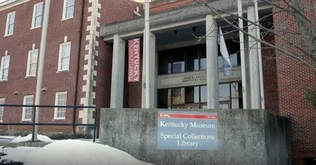
Video has Closed Captions
Clip: S31 Ep12 | 3m 34s | Chip Polston visits the Kentucky Museum in Bowling Green. (3m 34s)
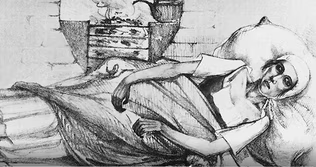
Lexington's 1833 Cholera Epidemic
Video has Closed Captions
Clip: S31 Ep12 | 4m 36s | A look back at the 1833 cholera epidemic in Lexington. (4m 36s)
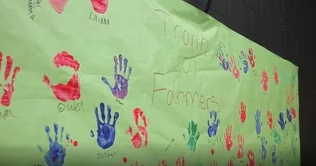
Video has Closed Captions
Clip: S31 Ep12 | 8m 2s | Jackson Independent School District -- preserving local agriculture and feeding hungry kids. (8m 2s)
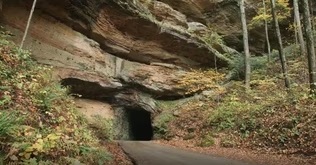
Video has Closed Captions
Clip: S31 Ep12 | 6m 46s | The history of Nada Tunnel, a former railroad tunnel and the "The Gateway to the Red River Gorge". (6m 46s)
Providing Support for PBS.org
Learn Moreabout PBS online sponsorship













Support for PBS provided by:
Kentucky Life is a local public television program presented by KET
You give every Kentuckian the opportunity to explore new ideas and new worlds through KET. Visit the Kentucky Life website.