
The Little School That Could
Clip: Season 31 Episode 12 | 8m 2sVideo has Closed Captions
Jackson Independent School District -- preserving local agriculture and feeding hungry kids.
Jackson Independent School District in Breathitt Co. is at the center of a community effort to preserve local agriculture and feed hungry kids in the process.
Problems playing video? | Closed Captioning Feedback
Problems playing video? | Closed Captioning Feedback
Kentucky Life is a local public television program presented by KET
You give every Kentuckian the opportunity to explore new ideas and new worlds through KET. Visit the Kentucky Life website.
The Little School That Could
Clip: Season 31 Episode 12 | 8m 2sVideo has Closed Captions
Jackson Independent School District in Breathitt Co. is at the center of a community effort to preserve local agriculture and feed hungry kids in the process.
Problems playing video? | Closed Captioning Feedback
How to Watch Kentucky Life
Kentucky Life is available to stream on pbs.org and the free PBS App, available on iPhone, Apple TV, Android TV, Android smartphones, Amazon Fire TV, Amazon Fire Tablet, Roku, Samsung Smart TV, and Vizio.
Providing Support for PBS.org
Learn Moreabout PBS online sponsorshipthe good people of Appalachia have a long history of joining together to face challenges.
And farming in Eastern Kentucky, well, that's a great example.
The Jackson Independent School District in Breathitt County is at the epicenter of an amazing community effort to preserve a way of life and feed a bunch of hungry kids in the process.
[music playing] Like a lot of Eastern Kentucky communities, Breathitt County faces major hurdles when it comes to preserving local agriculture.
Decades of strip mining and more frequent flooding have created serious issues, but a small school in Jackson is leading a community effort to shape a new future.
[birds chirping] I think if you ask people 20 or 30 years ago, if there was going to be a school buying thousands and thousands of dollars' worth of produce off a farmer, they would say, “No, I don't see that happening.” But when you get the school saying, “I want to support that,” that's all it takes.
And that's what's happened here.
Reed helped Jackson Independent School District obtain grants and partner with local farmers to create a farm-to-school program that just keeps growing.
My favorite part about working with this program is being able to work with the community.
I personally know the farmers.
They bring it here.
And I know that all of my kids are getting everything that they need.
And it's been phenomenal.
The kids are happier.
The food's better.
It's been great.
The beauty of it, we were able to use local farm food, fresh food, vegetables, meat, and provide those to our students.
As a community, our farmers are getting the money that they need to keep the sustainability of the farm.
But we're also getting the local farm where in our school.
So, it's beautiful partnership.
Jackson Independent is setting a great example for what can be done around farm-to-school programs.
They're making a big difference in our community with what work they're doing.
And it's not just about the farmers, it's about the kids eating fresher, fresher products produced locally.
I mean, that is more sustainable.
If we're able to support our community, what a great way to do this.
But also, we don't know what our students are getting the type of meal when they leave our school.
All we can control is what we have here when they're in our presence.
So we're gonna do everything in our power to give them a solid two meals plus a fresh fruit and vegetable snack.
The benefits of providing wholesome food to kids and supporting local farmers are obvious.
But the positive impacts of the Farm-to-School program resonate more deeply with both the students and the staff.
Watching the kids go from eating things out of a bag to coming here and having whole meals and homemade meals, things from scratch, and being able to watch them go from, “I don't know what I'm going to have,” to “ I absolutely want to go to school because I know it's going to be something good.” And that makes me feel good about my job.
[sizzling] You know, schools have got budgets for food.
So why not spend that money on something fresh, something local and support a local farmer.
Jackson Independent has 350 kids.
What if Breathitt school system started supporting it?
They've got over a thousand kids.
I mean, what if some of these larger school systems started supporting agriculture at the level that Jackson Independent did?
It could really change things in eastern Kentucky.
And Jackson Independent is all about making positive changes for the kids and the community.
Leveraging another grant, teacher Britni Tincher-Back created an agricultural sciences program in the middle school.
The program offers students the opportunity to explore career paths in agriculture.
I want them to have a taste of what a career pathway can be before they leave these doors.
And so many students have flourished in this class, showing me that they could make a career out of agriculture.
[chicken clucking] My favorite part would definitely just have to be getting out of the classroom every once in a while, because yeah, we got to learn in the classroom, but sometimes you got to get out of the classroom to learn too.
I would rather be on that farm than anywhere else, and to be learning stuff and to look forward to being at school every day, looking forward to this class all day long.
And then when it's over, you can't wait to do it the next day.
In education, we talk a lot about project-based learning, getting kids involved rather than the paper pencil, getting material in their hands, letting them problem-solve.
When you start looking at Miss Britni Tincher-Back's class, that is what they're doing.
So, we're building a skill set in our middle school students that, hopefully, they'll be able to continue for years and years to come.
As far as the business side of the teaching goes, they are in every sense of the word running their own business.
They collect their eggs every single day.
They raise these chickens from incubation.
As far as our canning goes, they had their own farmer's market operation.
The students are taking this opportunity seriously.
In fact, they're already turning a profit on products ranging from chickens and eggs to vegetables and canned and baked goods.
It's really important for us to be sustainable in our program because we have to have money to operate.
And so, them learning how to make a profit has been so.
it's just been exceptional because they have kept their program running on their own.
Dylan has the key.
As incredible as the Ag Sciences program is, Britni wants to give her students more professional experience.
That's why she's invited them to come help out on her family farming operation and work directly with her husband, Josh.
She tells the kids about our operation here on the farm where we live at and how everything is.
And they've taken interest into that.
A lot of people today say kids don't work like they used to, or all they want to do is play video games and stuff like that.
But that's not true.
Not all of them is like that.
And we've had some really good kids that have came down and helped out a lot.
And they've surprised us.
They really have.
And all of these new opportunities and experiences have had a huge impact on the types of students these kids are becoming.
And now, they've had kind of this drive to come to school because now they're becoming involved and they're becoming the leaders of the school.
So, what we're seeing is a change in increased attendance, less behavior disruptions, less office discipline referrals, and the grades are becoming better.
Why?
It's because the kids are enjoying what they're doing, and they have a reason to come to school.
The local community has a lot invested in these students, and for good reason.
After all, our youth is our future.
The future of farming in Breathitt County, sometimes when I think about it, I get a little sad when I think it may not be.
it's just it's dwindling.
And it's just, it's important to us because it's culture here.
It's a culture here that's dying quickly.
But I think in the next few years, I think we can turn that around with the future generation of farmers that's going through this program.
We're hoping that some of these younger farmers will take our spot.
We're hoping our children will kind of carry on the legacy.
Oh, boy.
Okay.
Are you gonna help Daddy in the field?
And then, I work.
And then, And then, when we go to [Kings Island], I'm going.
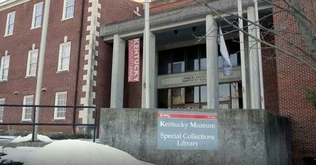
Video has Closed Captions
Clip: S31 Ep12 | 3m 34s | Chip Polston visits the Kentucky Museum in Bowling Green. (3m 34s)
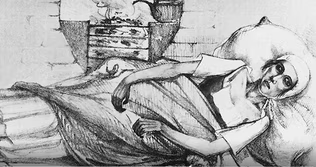
Lexington's 1833 Cholera Epidemic
Video has Closed Captions
Clip: S31 Ep12 | 4m 36s | A look back at the 1833 cholera epidemic in Lexington. (4m 36s)
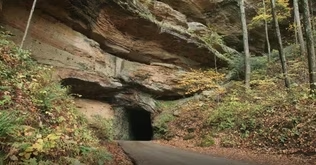
Video has Closed Captions
Clip: S31 Ep12 | 6m 46s | The history of Nada Tunnel, a former railroad tunnel and the "The Gateway to the Red River Gorge". (6m 46s)
Providing Support for PBS.org
Learn Moreabout PBS online sponsorship













Support for PBS provided by:
Kentucky Life is a local public television program presented by KET
You give every Kentuckian the opportunity to explore new ideas and new worlds through KET. Visit the Kentucky Life website.