
Our Story, Too: Women, Native Americans and African Americans in the Revolutionary War
Special | 56m 46sVideo has Closed Captions
Uncover the often-untold contributions of women, Native Americans and African Americans.
This documentary uncovers the often-untold contributions of women, Native Americans and African Americans during the Revolutionary War, highlighting individuals with South Carolina ties through expert commentary and dramatic reenactments.
Problems playing video? | Closed Captioning Feedback
Problems playing video? | Closed Captioning Feedback
SCETV Specials is a local public television program presented by SCETV
Support for this program is provided by The ETV Endowment of South Carolina.
Our Story, Too: Women, Native Americans and African Americans in the Revolutionary War
Special | 56m 46sVideo has Closed Captions
This documentary uncovers the often-untold contributions of women, Native Americans and African Americans during the Revolutionary War, highlighting individuals with South Carolina ties through expert commentary and dramatic reenactments.
Problems playing video? | Closed Captioning Feedback
How to Watch SCETV Specials
SCETV Specials is available to stream on pbs.org and the free PBS App, available on iPhone, Apple TV, Android TV, Android smartphones, Amazon Fire TV, Amazon Fire Tablet, Roku, Samsung Smart TV, and Vizio.
More from This Collection
Find content produced by SCETV.

Weathering The Flood: South Carolina 10 Years Later
Video has Closed Captions
Revisit the "thousand-year" flood of October 2015. (26m 46s)
Video has Closed Captions
Front Porch Carolinas takes viewers to important Civil Rights locations in the state. (27m 2s)
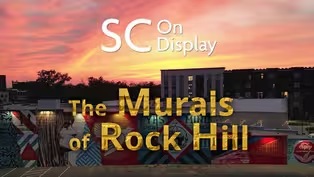
SC On Display: The Murals of Rock Hill
Video has Closed Captions
"'The Murals of Rock Hill'' spotlights this vibrant art community. (26m 46s)
Graceball: The Story of Bobby Richardson
Video has Closed Captions
At nineteen years-old, Bobby Richardson, became the starting second baseman for the Yankees. (54m 51s)
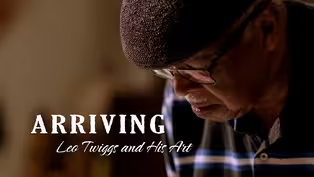
Arriving: Leo Twiggs and His Art
Video has Closed Captions
Dr. Leo Twiggs is an artist and educator in South Carolina. (56m 46s)
Video has Closed Captions
The Cleveland School fire of 1923 influenced building and fire codes nationwide. (56m 46s)
Video has Closed Captions
Explore the relationship between Reconstruction and African American Life. (56m 46s)
Video has Closed Captions
Part two continues the examination of the life of Cecil Williams. (56m 46s)
Video has Closed Captions
Explore the life of acclaimed civil rights photographer, Cecil J. Williams. (57m)
A Conversation With Will Willimon
Video has Closed Captions
William Willimon is an American theologian and bishop in the United Methodist Church. (27m 46s)
Providing Support for PBS.org
Learn Moreabout PBS online sponsorship♪ (rifles firing) Walter Edgar> This was a civil war in South Carolina.
It wasn't just a fight for independence; it was a civil war, and it was bloody, and it was nasty.
♪ Bill Davies> We wanted to focus on the people we thought were either underrepresented or unrepresented.
♪ Kassidy Plyler> The Catawba Nation was the only tribe to fight the entirety of the American Revolution alongside the Patriot efforts.
(rifles firing) Melissa Walker> The war created a lot of disruption, particularly for women.
(rifles firing) Orville Vernon Burton> People of African decent played a very important role in the American Revolution.
♪ Walter> Everybody was involved one way or another.
♪ Walter> Looking at the 250th anniversary of the American Revolution, uh, it is a national story, but it's also a local story.
(rifles firing) Bill> We wouldn't be what we are today without the outcome of that event.
We in the commission try to say we were fighting for independence.
We particularly avoid the word freedom because many of the people, in fact, most of the people in South Carolina did not get freedom in that war.
(rifles firing) So independence is what we were fighting for.
(rifles firing) Ken> And let us remember; this is not just our image of the militiamen, the sturdy farmer.
We're talking about enslaved people, free black population, Native population on the west, but also Native population integrated and involved in the daily life of the colonies.
And the other thing is we're not talking about women.
Um, the majority of the population, they're involved at every angle in the resistance, in the opposition to the resistance.
It's a very, very complicated dynamic.
And we owe, we have an obligation to them, not to sanitize it, not to romanticize it, not to make it a kind of sentimental thing that is devoid of the violence, but also of the inspiring ideals that are at the heart of our revolution.
♪ Bill> One of the things we did as a commission when we were formed, we talked about the fact that most stories of wars tell only the story of the men who fought.
(rifles fire) And we decided that we wanted to tell the story of everyone who lived in what became the state of South Carolina from 1770 to 1783.
But we wanted to focus on the people we thought were either underrepresented or unrepresented.
Walter> It wasn't just the story of Sumter, Pickens, and Marion.
This isn't the Marion's men of, uh, Walt Disney.
His, his band was an incredible mixture of, uh, white, black.
and they weren't there to be cooks.
They were there.
They were there to fight.
The Catawbas fought with the Patriots against the British, something that's not often remembered.
And, uh, some of the greatest spy stories of the American Revolution in South Carolina have to do with, uh, the role of women acting as, uh, messengers.
They're part of the story.
They're part of the story.
(nature sounds) Evan Nooe> The lead up to the American Revolution for indigenous people, I mean, goes back centuries in terms of how native people have populated, inhabited, and transformed what becomes the state of South Carolina.
Um, so indigenous people have been in the Americas for thousands of years, and South Carolina has certainly been home to a variety of indigenous peoples.
Lamar> Well, the Cherokee people have been here for 3,000 years coming from up north.
We were the largest group of Native Americans in the Southeast.
Uh, here in South Carolina there were smaller tribes.
Uh, the Catawba was the next largest tribe over near Rock Hill.
♪ Kassidy> The Catawba Nation, um, we refer to ourselves as the Iswa, or the people of the river.
We have lived in the Piedmont regions throughout the Carolinas up into parts of Virginia.
Our village is spanning across those areas for six to 12,000 years.
Lamar> We traveled, and we traded, and we hunted all over this area down here.
So, life was good for us until Europeans came.
Kassidy> When we were first contacted, it wasn't until the 1500s by Explorer Hernando DeSoto, when he came up throughout modern day Florida, and eventually reached what would be South Carolina.
Reached a village.
Of course, he was looking for gold.
Our people had no idea what gold was at the time.
That was our first contact with Europeans, and it really wasn't until the 1700s when people really started to move into the area.
At that time, our leadership realized that we are not the majority of people anymore, and if we had any hopes of survival, we would have to align ourselves with those that are the majority.
So, um, most notably King Hagler, or in our community, as we are referring back to his Catawba name, Nopkehee.
He was our noble leader, and he was very diplomatic in realizing that European settlers were going to be the majority, and if we wanted to survive, we're going to have to be their allies.
Lamar> Well, the Cherokee chiefs had decided that it was time to take back their own country or, well, we didn't call it country because we didn't, we occupied land.
We didn't own land, you know, Europeans owned land, and they had boundaries on their land.
We had no boundaries.
And so, it was time for the Cherokee Chiefs to take back, you know, our homelands.
Evan> At mid-century, mid-18th century, we see the French and Indian War, and the Cherokee are going to be involved in this with their own designs of trying to preserve indigenous land.
Lamar> But it's like I tell children sometimes, uh, if someone showed up on your doorstep and they said, uh, we want you to leave your house and leave all your food.
We're taking everything from you, you know, you try to defend yourself.
And that's what the Native American people were doing.
Evan> The Catawba certainly aren't fighting in defense of, uh, taxation without representation within the British Empire.
But I think that they are aware, um, that the colonists might be willing to recognize their territorial sovereignty.
So, we see the Catawba and the Cherokee taking different strategies based on their circumstances, uh, based on what they think they can achieve, um, at the start of the American Revolution.
Kassidy> The Catawba Nation was the only tribe to fight the entirety of the American Revolution alongside the Patriot efforts, it did create and enhance more of the, the hostility between some of our neighboring tribes, especially with the Cherokee.
The Cherokee aligned theirselves with the British.
Lamar> The British has convinced the Cherokee people that if they would side with them, that what they would do was give them all their lands back.
And they would run the colonials out.
And the Cherokee people should have known that wouldn't have happened, because every treaty that was ever signed to the Cherokee people was broken.
Every one.
Evan> We see indigenous strategies of warfare are traditionally very different than how colonists are trained; how European armies are trained.
And we see smaller bands, more mobile bands of warriors striking against an enemy, as opposed to, uh, the company approach to militias or, uh, uh, regulars in European or patriot armies, you know, forming a line of battle, going out into the field and firing at one another, or trying to hold a position, uh, on top of a hill, behind a fence, and then assault that position.
(rifles firing) Kassidy> During the Revolution, there were the guerilla warfare tactics, and you had your Minutemen in, um, King's Mountain.
And the way they fought was not very militaristic at that time, but it was a tactic that they also picked up from the indigenous people here.
From the Catawba people helped them learn these different tactics in battle.
Bill> They had talents; they knew how to fight in the, in the woods.
Uh, in the first years of the war, when we were fighting the Cherokee, almost every major militia, of officer on both sides fought against the Cherokee.
So, they learned the way the Cherokee did not stand in lines.
They stood behind a tree, which makes a whole lot more sense, and they fought almost a guerilla-type warfare.
And so, our militia people learned from them.
(rifles firing) Evan> So, a lot of my work is revolved around the, the memory of violence between indigenous people and settlers.
Um, and one of these really representative examples is what happens to the Hampton family in what's now Upstate South Carolina.
Um, so at the start of the Cherokee War in 1776, they're going to target settlers that are living along the Indian boundary.
The Hamptons are going to be one of these families that basically moves into that buffer zone.
Um, and we're going to see that the Cherokee are going to bring some very devastating raids against these settler households.
They are looking to basically roll back settler encroachment, uh, along their borders.
And to do so, that means they are, uh, killing families that have encroached.
They are burning homes that have been built, uh, in this buffer zone.
We're going to see Anthony Hampton killed, his wife Elizabeth Hampton killed, his son, their son, uh, Preston killed, and then an unnamed grandchild, uh, will be killed.
And the story of their deaths is going to become sensationalized.
Um, it is going to be passed on through generations, put into the press, put into, um, magazines and repeated for more than the next century.
But we see a lot of this get all folded in together into this memory of the Cherokee War, vilifying the Cherokee, but all indigenous people.
Settlers begin portraying themselves as the victims.
That they have encroached on, uh, Native land often gets, uh, erased, and that they become sort of these helpless victims of an unsuspecting Indian attack.
Uh, and that memory is going to be passed on from generation to generation, and eventually, in many cases influenced sort of our public commemoration, uh, of these events.
Um, so much so that by the 1930s, um, the United Daughters of the Confederacy will actually put a monument commemorating the loss of those, uh, initial Hampton family members.
They will label this the Hampton Massacre.
Walter> As the Revolution developed, the Cherokee launched an attack on the frontier, uh, which was brutally put down from Georgia to Virginia.
The militia of the states did it, not the Continental Army, and, uh, pretty much ended the Cherokee in South Carolina.
Eventually they were expelled.
Lamar> The colonial people, uh; the soldiers were going into the major village sites of the Cherokee people, and they burned all the crops.
And then they burned their villages, and they killed a lot of the Native American people that was there.
They even killed children and women that was in those village sites.
It was horrific for the Native American people.
And so, we lost momentum to be able to fight.
Uh, we had nothing to eat.
And because of that, eventually the Cherokee gave up.
The majority of the Cherokee, uh, decided it's time to stop fighting, and we will try to assimilate into the culture of the white people that was here.
Evan> So, we're going to see that this precedent in terms of indigenous land loss, be characteristic of what goes on throughout the American Revolution, certainly in the aftermath of the American Revolution, as the United States looks to expand westward.
And those precedents revolve around basically villainizing indigenous people, uh, uh, destroying towns and communities, uh, by forced relocations and dispossession.
We see other instances, though, in which groups like the Catawba are going to try to navigate staying in their homeland.
So, Catawba will be very successful in doing so, but it won't be without challenges.
Kassidy> During the Revolution, we aligned ourselves in hopes to protect the treaties that were signed.
Eventually, after the Revolution, of course, throughout history, and at times, these treaties were not kept.
Um, we would reach out to the leaders in hopes to what are we going to do about the people who keep moving into this area that was designated as Catawba land?
So, the Catawba started reaching out to political leaders.
They would go to George Washington.
They wrote to him, and he didn't do anything about it.
They actually went to his home in Mount Vernon.
He wrote a letter to the U.S.
Secretary of War at the time, and said he had been incommoded by a dozen Catawba at his home in Mount Vernon, meaning he had been inconvenienced by them for several days, where they came and actually basically squatted on his yard to try to get answers.
We wanted answers on what are you going to do to honor this treaty to protect our land, uh, to keep people from moving here?
And eventually it was into, uh, the Civil War, and into the 1800s where eventually the Catawba Nation went into the Treaty of Nations Ford, which was with South Carolina, and ceded the rest of our land.
And so, we're put onto 600 acres.
That was the reservation where we are today, um, but since 1993, we have expanded those 600 acres, but in the same area.
It is part of our ancestral homelands.
Not many tribes, especially on the east coast, can say that their reservation is still in their ancestral homelands.
We can, as Catawba, and I think that is in part of our allyship with those settlers that settled in the area, that did align themselves with the Patriot cause, that did eventually go to the Revolution, fought in the Revolution, and establish what is America today.
Lamar> You know, we progressed, and we moved forward, and today there's Native American people here.
There's Cherokee people here.
And we're trying to teach our children today about our past.
We learn from the past, and we learn from our elders.
And that's what we're trying to teach our children today.
And what's behind me is something that I wanted to build for a long time.
I'm very proud of my ancestry, and also of the prehistoric people that were here first.
And so, many, many years ago, my son brought those large stones that you see standing back there to us.
And so, I said, "Well, I'm going to stand those stones up.” And they have Native American Carvings on ‘em.
They're called petroglyphs.
And I did that by hand without modern tools.
I used antler and stones and wood to carve those in there.
And they represent the prehistoric people that were here, and the Cherokee people that were here.
And I come out here often, and I sit down, and I think about the Native American people from long ago, and the prehistoric people.
And, uh, I sit with these stones, and I talk to these stones, and they bring me joy and happiness when I'm out here.
And I do flint napping and, uh, make arrowheads and spear points like the people did many, many years ago.
And I carve soap stone bowls, and have mortar and pestles, and I grind ochre, which was used to paint faces and put pictographs on the stones and so forth.
So, it's, uh, it's something that brings me back to the past.
♪ Melissa> So, life for women in, in the colonies before the Revolution varied a great deal depending on where they lived, on whether they were free or enslaved, whether they lived on the frontier or in a town, on what their families did for a living.
So, it's really hard to generalize, but we can say that for white women, the expectation was that they were to serve their families.
And their legal status really reflected that.
Their legal status was a Latin term called fem covert.
And it implied that their legal identity was covered by a man's, a father, or a husband.
And so, legally, women didn't have very many rights at all unless they happened to be single women or widowed women who owned property.
But for the most part, women were considered to be the property of their husbands.
And then on the frontier, you have women, white women, who are even working in the fields at certain times of year or tending to the livestock.
Bill> The war couldn't have been won without the women, particularly those not in the cities.
In back country South Carolina, and, of course, people in Charleston suggest that's anywhere west of Calhoun Street.
You had women who were left at the farm when the husband went off to fight.
They had to maintain the farm; they had to keep the crops going; they had to take care of the children.
Walter> If you're going off to fight with Sumter or Marion, you're a yeoman farmer.
Who is going to take care of the field?
Who is going to and we're not talking about people who have servants either, either indentured or, or slave.
Somebody's got to run the place.
And it's, it's the women.
And also putting up with having to confront the British firsthand.
And people like Tarleton were not very nice in their treatment of, uh, patriot women.
(rifles firing) (shots continue) Melissa> Certainly, any woman who comes into contact with the fighting, whether its militia fighting in the back country, or whether it's the occupation of Charleston, those women are going to find their daily lives disrupted.
Um, for example, we have accounts from a Charleston woman named Eliza Wilkinson, who talked about soldiers coming into the house once the city was invaded, and British soldiers stealing everything down to their dresses, their shoe buckles, even the doors and shutters off of the house.
So, these women are finding daily life very disrupted.
And in the back country, the same thing is going on.
And both loyalist and militia women are getting caught in the crossfire.
♪ With General Washington's army in particular, and to some extent with Nathaniel Green's army here in the South, there were groups of women called camp followers.
And that's a term that often people think refers to prostitutes.
And there were prostitutes who traveled with the army, but most camp followers were actually wives of soldiers who really had no way of making a living.
And so, they would follow the army from place to place.
They would do laundry.
They would bake.
They would do nursing.
They would cook.
The war created a lot of disruption, particularly for women, um, from the lower ends of the socioeconomic spectrum.
♪ Bill> One of my favorite women in the war is Elizabeth Hutchinson Jackson, who happened to be the mother of one of our future presidents, Andrew Jackson.
She had several, uh, members of the family that were fighting on the patriot side, and at the horrible Battle of Waxhaws, which resulted in what we call Buford's Massacre.
And there were any number of very seriously injured, very seriously wounded, um, patriots on the field.
She was in the middle of taking care of those people.
She started at that point.
Sometime later, two of her sons, including Andrew, who was called Andy at the time, um, were captured by the British.
They also caught some diseases while they were in the prison.
Those prisons were horrible places to be.
And she went down to Camden, to the commander of the British forces at the time, Lord Rawdon, and convinced him to let her take her two sons home.
Melissa> She became sort of a martyr for the cause, because in 1780 after the fall of Charleston, she travels to Charleston.
The legend is that she was going to serve as a nurse for the prisoners of war.
Probably most sources say that she was actually going to try to secure the release of two of her nephews who were being held prisoner.
Patriots who were imprisoned at Charleston were held on ships out in the harbor, and those ships were infested with various diseases.
And she went on board one of the ships, she contracted some disease.
It was probably typhus or cholera, and she died in Charleston, um, in the summer of 1780.
Bill> Somebody like that, you can't; it might be a small incident in a large war, but to the people around her, she was the most important thing in their lives as their lives were leaving them.
And that's just a wonderful thing when you, you're putting yourself out there knowing that you're probably not going to make it yourself.
So, I, I can't help but respect somebody like that.
♪ Melissa> There were a lot of women who participated either by carrying messages or by, um, spying and, and contributing intelligence.
Carrying intelligence from one militia unit to another, or one army unit to another.
Um, there are several stories about women who contributed intelligence that helped the continental army at the Battle of Cowpens.
♪ Andy Thomas> Emily Geiger.
Wow, that's a great legend, uh, for the Midlands.
Um, Emily was supposedly a young girl, and she was given the task of delivering a message from General Nathaniel Green to General Thomas Sumter.
And to do so, she had to ride through British territory.
Supposedly, she was captured, taken to the upstairs of Fort Granby.
The commander said he was too much of a British gentleman to search her.
He was going to send for a Tory maiden to come in and take a look.
And so, they locked her in the room, and Emily got her message out, which was written on a piece of paper.
She memorized it as quickly as she could; she tore it up into strips; she put it in her mouth, and she ate it.
And when they came in to search her, they couldn't find it.
And supposedly she rode away the next day, and she was able to get to General Sumter's Camp and deliver the message verbally to Sumter.
So, this is a great legend, and we, we love our legends, but we're not really sure that Emily existed.
The story itself is an oral story; it doesn't actually appear in print until, uh, 1824.
We can't find no documents, military documents or, or otherwise, other than this oral story.
She may have been real, but we don't have a way to, um, actually document that.
However, she represents a great archetype, an archetype of women who are making sacrifices to win the, the Revolution.
It's a great story.
We love to tell the story of Emily, and we think it's a great legend that needs to stay around for a while.
Melissa> I think a lot of times when we look at history, there are a lot of stories that are embellished legends, and it can still be valuable to tell those stories.
We just have to say, here's what we know for sure.
Here's what we can't know for sure.
But this story seems likely for these reasons.
There's no doubt in my mind that a lot of women were carrying messages to troops.
There's no doubt in my mind that a lot of women were, um, reporting on the locations of troops.
So, there are a lot of things that women did to help the cause that passed under the radar.
♪ Bill> Rebecca Motte is a well- known story in South Carolina.
She had family in Charleston.
Her brother was Miles Bruton, and she... when he died, she took over a house there.
She was married; she wanted to move to a plantation home.
She had, she built a house there, a very nice new house, and moved into it.
And then the British decided they needed it as a fort along the road to protect the, the supply road.
And they built a stockade around her house and called it Fort Motte.
When Francis Marion came to try to take Fort Motte from the British, they decided to try to set the house on fire to make the British give up.
Rebecca Motte found out about it, and the story is that she went and found some fire arrows on a bow that her husband had gotten from a trip to Africa and gave it to them.
Not only did she freely say, yes, go ahead and burn my brand-new house, but she helped provide the tools to do so.
They did.
They were successful in setting the house on fire.
The British eventually surrendered, but after the surrender was over, Ms.
Motte invited all of the officers of both sides to dinner that night and fed them together for both the people who had caused her house to be burned, and the people she had told it's okay to burn it.
Um, we have a lot of strong-willed women in South Carolina, and this is what, this is what they come from.
♪ Walter> Probably the greatest heroine, Jane Black Thomas, her husband had commanded the Spartan Regiment.
He was captured and he was imprisoned at the Star Fort Ninety-Six.
Well, he got sick, and of course, in the days of the revolution or anytime, they weren't taking care of, of prisoners; they put the word out; "You come take care of your husband."
Well, she did.
And, um, she overhead some British, British officers' wives talking about they were going to have a raid up in Spartan District as it was then known, uh, on the Spartan Regiment, which was not commanded by her son.
So, what this woman who was over 60 did, she stole a horse, rode over 50 miles through enemy occupied territory to warn this, the, uh, Spartan Regiment.
And they, in turn, ambushed the British Raid uh, at Battle of Cedar Springs.
Now, as I have often said, who, what was more heroic?
Jane Black Thomas, an agent women stealing a horse riding through enemy occupant territory, and it wasn't on a turnpike.
And Paul Revere riding down a paved road saying, the British are coming.
The British are coming.
She completed her mission.
He didn't.
(rifles firing) Melissa> There are probably a dozen or more known instances of women actually participating in the fighting as soldiers.
And these are women who would dress as men and become part of an army or a militia unit.
In the South, we know that a woman named Sally St.
Claire dressed as a man and served in, militia units in Georgia, and then with the Continental Army, and she died in the siege of Savannah.
♪ Carin Bloom> The Sons of the American Revolution in Philadelphia sponsored a conference back in 2017 or 2018, and it was about women's experiences in the Revolution.
And the request was for scholarship that was less well-traveled, and so I offered Lucy Banbury's story, because she was a woman who self-emancipated from Declaration of Independence signer, Arthur Middleton, here in South Carolina.
And she essentially became one of the Black loyalists who was sent to Nova Scotia after her service to the British Army and ended up a free property-owning woman.
So, her story was previously unknown.
The pieces of it had been collected by Middleton Place Foundation, but I was the one to create them into a narrative so that we could present her story alongside these other women's experiences of the Revolution.
♪ Bernard Powers> Phyllis Wheatley, for example, an enslaved woman, and the first slave, and the first, uh, African American to write a book of poetry in the 1770s that supported the American patriot side.
Carin> Phyllis Wheatley's story is, is pretty unique.
The fact that she was enslaved in New England, the fact that she was educated, that she was a poet.
She wrote patriotic poetry.
When she went to England in 1773, it, the decree at the time, the law there was any enslaved person that set foot on English soil was free.
So, the minute she stepped off the boat in England, she was a free woman.
When she came back from England, nobody argued, nobody put up a fuss.
Nobody tried to re-enslave her.
Melissa> In the Cherokee Tribes, families traced their lineage through the women.
So, you kept track of who your mother's relatives were, and your father married into the mother's family.
Very different from the patriarchal notions of the British was not female dominated, but it was a society where women had a whole lot more voice in public decision making.
♪ Kassidy> During the Revolution, part of this area was a place for people fighting in the Revolution to come.
It was an encampment where they could come and get supplies and foods and clothing.
It was just supplied by Catawba women.
Evan> For indigenous communities in Eastern North America, generally at large, men are going to traditionally be hunters, warriors; Women are going to be agriculturalists, and stewards of the land, um, for both Catawba and Cherokee people.
For the Catawba, it might mean that they have resources to provide the American patriots when they need supplies.
If men are away fighting or hunting, the women are going to be in control of the land, particularly important.
They're going to be in control of what the land produces, what is done with that land, what is done with its products, how that harvest is distributed.
♪ (men yelling and rifles firing) Melissa> I think there's a myth that wars were historically male enterprises.
And we often forget that wars, especially wars fought in the place where you live, engulf everybody in the conflict, and they pay a price even if they're on the winning side.
♪ Bernard> The Black presence in South Carolina prior to the American Revolution was, was a long one.
And that presence was very important.
Orville> We date slavery in two ways.
I mean, the standard is 1619, and that's when the Dutch ship, uh, brought, uh, into what became Virginia, the colony of Virginia.
Uh, people who were sold either as some controversy on this, enslaved people or indentured servants.
And that's the general statement of when we have the beginning of racial slavery in the United States.
But we also, a lot of people, like to date it to earlier in South Carolina, or some would argue as Georgia, when the Spanish bring in fact enslaved people there.
Bernard> By the, uh, end of the 1690s, South Carolina is producing rice.
And rice was a very labor-intensive crop, and it required, uh, a large labor force.
That ensured that as early as 1708, the majority of people who lived in the area of South Carolina were people of African descent.
So, uh, it was the only one that had a Black majority out of the 13 mainland colonies.
And so that made it unique.
♪ People of African descent played a very important role in the American Revolution.
First of all, there was the idea of slavery.
So, if you think about, and if you look at the rhetoric that was used by, uh, this patriotic generation, I mean George Washington, Patrick Henry, William Henry Drayton here in South Carolina, one of the things that, that they said frequently as a part of their rhetoric was that King George III, parliament, and the British government was attempting to enslave them, and they urged their friends and neighbors and leaders to resist.
So the, the institution of slavery helped this patriotic generation understand and value freedom and what it meant, because they were surrounded by the absence of freedom that they themselves, in many cases, were creating.
Bill> A Virginia, uh, governor up there promised freedom to any slave who escaped and came over to the British side.
And that was sort of accepted across the 13 colonies.
The slaves thought if they got to British lines, they would be free.
The British became the new saviors.
Bernard> And that was a, that was a rumor that circulated widely throughout the colonies and especially in the South.
That kind of fear, that apprehension would have a special resonance in a place like South Carolina, which was the only colony that had a Black majority.
Orville> If you believe in liberty and freedom and inalienable rights, what do you do if you are an African American?
It showed me that on both sides you had enslaved people having to work.
And then you have enslaved people who are also fighting with the American patriots.
Walter> In the attempts to, to recruit slaves, John Laurens, the son of Henry Laurens, um, one of Washington's key aids, argued that slaves should be recruited and freed, and that measure twice died in the South Carolina General Assembly.
That was not going to happen.
And the British, by the way, didn't, did not always honor their promise of, of, uh, of freedom.
Bernard> During, during the war, there were, there were many, uh, Black men that joined on the British side.
When the British leave, they will leave with thousands of those people that had supported their cause.
And, uh, many of those people end up, uh, free in various parts of the British Empire.
Some, unfortunately were betrayed, and they were taken to the Caribbean where they were resold into slavery.
So, they were, in fact, double crossed.
Carin> There was a fellow named Boston King.
He was enslaved here, and he escaped from Charleston.
And he talked about — this is a rare example of quotations that we have from formerly enslaved people and Boston King is quoted as having said how anxiety inducing it was to be in New York, to have been inspected to go with the Black loyalists, and to be waiting and to be waiting for the ship, and to be waiting for the evacuation.
And he said, "Everybody is frightened.
We have seen masters come from Virginia and further south and taken their slaves by the hair and pulled them home.” Just people reclaiming what they considered their property, human beings.
And he said, “We are looking over our shoulders because we have seen with our own eyes, enslavers come and physically drag their enslaved back to the plantations."
And he is quoted as having said that.
So, a rare instance of a male enslaved voice of his own saying, this is what we are experiencing.
We should be talking about that, too.
♪ Durant Ashmore> One of the most heroic individuals here at the Battle of Ninety-Six was Thomas Carney, who was a free Black from Maryland, and he fought with the first Maryland Regiment.
These were fellas; these were Washington's and Morton's.
Bernard> Carney ultimately finds himself in South Carolina.
And, uh, he was...recognized as a fearsome and bold soldier, a real military leader, bold and daring.
And, he would distinguish himself here in South Carolina, uh, at the Siege of Ninety-Six.
♪ Durant> Thomas Carney volunteered to join that 50-man unit that was referred to throughout history, evermore as the forlorn hope.
Green had to crack this nut.
Rawdon was a day and a half away.
It was now or never.
So, he charged these 50 men right into the teeth of this fort.
The battle raged on, uh, Captain Perry Benson was wounded, seriously wounded.
That was Thomas Carney's commanding officer.
And when the, uh, retreat began, Thomas Carney could have turned around and run right as fast as he could, but he did not.
He picked up, Captain Benson, put him on his shoulder, and with that added burden, he ran through rifle fire, as he went to safety.
And he saved, Captain Benson's life.
That's one of the most heroic acts of the Revolutionary War, and it happened right here.
And Captain Benson and Thomas Carney were friends for life after that.
♪ Bernard> Tony Small was a fugitive slave here in South Carolina.
And after the Battle of Eutaw Springs 1781, the fall of 1781, he was wandering through the battlefield, and he came across a severely injured British soldier.
And rather than leave him, he took him to his residence, nursed him back to health.
And as it turns out, this man was an Irish aristocrat, and he was so grateful to Small that he offered him freedom, because remember, uh, Tony Small was a fugitive slave.
They will leave together from South Carolina in 1782, and they go to Ireland where, uh they'll take up residence in Dublin for a while.
Bill> Because of that act of humanitarianism, the commission created what we call the Tony Small South Carolinian Humanitarian Award.
We think that's one of those stories of he, he didn't save him because he was a patriot or he was a Tory.
He saved him because he was a man.
And we think that deserves respect.
♪ Bernard> There are other stories about individuals that, that really, uh, reveal the long reach of the American Revolution and the creation of the African Diaspora as a result.
One of the best examples of that is John Kizell.
Uh, and his story is a very unusual story.
Kizell, uh, was from Sierra Leone, West Africa.
And Kizell was swept up in the Atlantic slave trade, it seems, by the early 1770s, and was brought to Charleston, South Carolina, where he was sold.
Uh, he would eventually run away during the American Revolution and joins the British side where he works for the British.
Uh, the war is over with, and since he has cooperated with the British, they allow him to depart with them.
And so, 1782, he's, he leaves Charleston and heads up into the area of Nova Scotia.
Kizell and, and his family decide to relocate further.
And what they'll do in the early 1790s is they'll journey to West Africa, back to what is now, uh, a small colony that the British have, uh, established in West Africa.
And it's the settlement of Freetown, which grows into the larger colony of Sierra Leone.
So, it was very unusual for an enslaved person brought to the new world to be able to return to their own place of birth, but Kizell was able to do that.
Orville> I've always found it very interesting.
Indigenous people like the Cherokees and others, did not really fight for citizenship so much.
They wanted sovereignty as a people and a nation and wanting to be separate.
Yet almost all African Americans only wanted to be citizens and have equal rights.
So, you have these two different groups of people seen as different, and particularly on the frontier and out to the west, they're asking for two different things, and it has just always fascinated me that African Americans only wanted to be those rights guaranteed.
and that became in the Constitution, the idea that we are created equal and have the inalienable right, and have the same rights as white people, as citizens.
(various animal sounds) Jai'Lyn Lowe> The event is called By the Sweat of our Brows, and today we're having different activities.
We're joined by lots of Brattonsville descendants because this event is about their ancestors, and about them as people themselves.
Announcer> Francis age 14, Steven age 25, Oliver age 50, Catherine age 45.
Lisa Bratton> Brattonsville is my passion.
I first came here when I was very young.
I don't know, maybe about six.
And so, I've always known about the connection here.
So, um, this place is, um, is part of me.
My great-great grandparents were enslaved here, and went on to become among the first, uh, freedmen to purchase land in York County.
And the land is still in our family.
So, from a legacy of enslavement, this, we were able to build and prosper, and the family has prospered and thrived.
♪ Christopher Cathcart> I am here today, um, twofold.
One, my father, Wiley Cathcart's been a driving force in getting people to come out and support The Sweat of our Brow event, and to recognize the history of this area as it impacts all the so-called descendants.
But I'm also here because my great-great-grandmother, Lila Crawford, was held as a slave here.
And it's very seldom you get an opportunity to actually, visit a place where you can trace your, your direct ancestry to an individual, to a very specific place.
So, um, while I'm sure that's a lot of pain associated with coming to a place like this with the memories that you may have, I think it's important to acknowledge that this existed and, and how it existed.
And more importantly to, to acknowledge the people that actually were here, if nothing else, to come here and pay respect to her and what she went through and how she, through whatever struggles and trials and tribulations she had to endure, um, set the foundation for my family and also to be able to convey to the generations that come next, the importance of not forgetting that these things happened.
As painful as it may be, it's important that we, we discuss it so we can move on.
♪ Jai'Lyn> I think it's really important for people to come to a site like this and to learn where we've come from.
Um, I went to this college down the road.
Did not know about this place until sophomore year.
Um, so I think it's just, it's just important.
♪ Bratton Holmes> So, the state of South Carolina has as rich of a history as any place in the United States.
Looking back on everything that has happened in this state gives a very, I think, very good microcosm of, of the American experience.
And one part of that is that it hadn't all been pretty.
There have been gloriously wonderful things that happened in the state of South Carolina over the course of the, the past two and a half centuries.
And there have been some ugly things.
I've read a lot about some of those ugly things because frankly, my family was involved in some of them.
♪ Just because something is ugly and just because it's unpleasant to talk about doesn't mean, mean that we should forget it historically.
If we do, it increases the likelihood that the same thing will happen again.
♪ Melissa> The Revolution generated a lot of conversation about all men being created equal and about everybody possessing certain basic inalienable rights.
And there were women who advanced the idea that, that should apply to women as well.
I think family history can be a really powerful way to get people today to engage with the past and want to understand it because it becomes very personal when it's someone you are related to.
When we realize that history is made by people like us then it helps us to understand the importance of understanding what came before.
Bernard> The idealism of the Revolution, the notion of, of liberty and justice, that kind of idealism did not affect the lower South in the same way.
It had some impact in the upper South, but, uh, not so much in South Carolina and Georgia because these places were far too dependent on slave labor.
Walter> I've said it a lot of times, and it's been now said in public by other, by elected officials.
Our state's history is complicated.
It's not easy.
This was a civil war in South Carolina.
It wasn't just a fight for independence; it was a civil war.
And it was bloody and it was nasty.
(riles firing) Ken> This is the first Revolution that had proclaimed the unalienable rights of all people.
Um, however, limited its writers felt, it was nevertheless a foot in the door.
It was deeply, deeply meaningful to people who weren't going to be extended those rights.
But the second the Patriots began using the metaphor of slavery to define what King George and the Parliament was doing to them, then the question of slavery came up.
And once you say that there's certain universal rights that all men are created equal, you've already opened the door and it's over.
It's done.
Now, unfortunately, it takes four score and, you know, nine years, uh, for it, for it to be done.
But then it takes an amendment and another amendment, and another amendment.
And there are a lot of people today that would say it's still not over.
Uh, and so, you know, we are constantly, we have with these aspirational documents, just that.
Aspirations to perfection.
Evan> The legacy of indigenous involvement in the American Revolution is something I think can be said about all of American history.
That indigenous people are influencing the causes, conduct, and consequences of this event.
Um, they're going to be present, they're going to be participants, and they're going to both impact the American Revolution and be impacted by these historical events.
We certainly see, uh, a missed opportunity in terms of fulfilling the ideals of the American Revolution as it relates to indigenous people.
Um, but, uh, thanks to sort of the promises of the American Revolution, those ideals weren't necessarily abandoned.
They were delayed and there will be suffering until there is a recognition of what was left out.
Many indigenous groups, uh, across the nation still looking for Federal recognition, uh, still looking to reclaim native lands that have been lost, uh, at times just looking for acknowledgement that they still exist.
Carin> When our founding thinkers were talking about the American experiment, I think it's perfectly named.
They didn't create something that they felt was complete, finished, done, perfect as it is.
They created an experiment, something that needs to continue to be tested, something that needs to continue to evolve, something that needs to be revised as more information comes to light.
And I think it is important to look back at this because it isn't finished.
It wasn't then.
It isn't now.
There is still a lot to do.
There's a lot to revise if we choose to.
Bill> To me, this is an opportunity to make other people have the, the chance to learn about South Carolina and about South Carolina history and how important it is to what we have today, and hopefully make our children, our grandchildren, our great-grandchildren, as proud of being South Carolinians as I was taught to be before I was 10 years old.
♪ Orville> It's a complicated legacy for the enslaved, but ultimately I think what it means was as part of this revolutionary age, when you hear, even if you're enslaved, people talking about freedom, liberty, that they are enslaved if they don't have their rights.
You see both the hypocrisy, but the hope of freedom.
And that's what America is about, and why this Declaration of Independence and what they claimed the American Revolution was about would be inspirational and something to hold on to, and to continue to strive for freedom then and even now.
♪ Walter> The idea that this was a conflict that involved the entire population of South Carolina regardless of race, class, or gender.
It was everybody was involved one way or another.
Their stories sometimes are told, sometimes they are not.
They make fascinating, fascinating reading, and good history is a story.
It's not a memorization of facts.
Um, and the role that South Carolina would play in the Revolution was absolutely crucial.
♪ (rifles firing) ♪ (firing continues) ♪ (rifles firing) ♪ (firing continues)














Support for PBS provided by:
SCETV Specials is a local public television program presented by SCETV
Support for this program is provided by The ETV Endowment of South Carolina.