GBH Documentaries
Love, Chinatown
Special | 18m 37sVideo has Closed Captions
Cynthia Yee and Gwen Liu take viewers on a vibrant walking tour of Boston’s Historic Chinatown.
As Historic Chinatowns worldwide are squeezed by shifting demographics and urban development, Boston's has cultivated a resilient spirit of self-advocacy embodied by protagonists Cynthia Yee and Gwen Liu. From bakeries and dim sum shops to mahjong clubs and banquet halls, Cynthia and Gwen present the neighborhood's journey as a testament to community, adaptability, and telling one's own story.
Problems playing video? | Closed Captioning Feedback
Problems playing video? | Closed Captioning Feedback
GBH Documentaries is a local public television program presented by GBH
GBH Documentaries
Love, Chinatown
Special | 18m 37sVideo has Closed Captions
As Historic Chinatowns worldwide are squeezed by shifting demographics and urban development, Boston's has cultivated a resilient spirit of self-advocacy embodied by protagonists Cynthia Yee and Gwen Liu. From bakeries and dim sum shops to mahjong clubs and banquet halls, Cynthia and Gwen present the neighborhood's journey as a testament to community, adaptability, and telling one's own story.
Problems playing video? | Closed Captioning Feedback
How to Watch GBH Documentaries
GBH Documentaries is available to stream on pbs.org and the free PBS App, available on iPhone, Apple TV, Android TV, Android smartphones, Amazon Fire TV, Amazon Fire Tablet, Roku, Samsung Smart TV, and Vizio.
[ambient noise of city neighborhood] - I can't believe on my 75th birthday somebody wants to make a movie of me.
That's kind of rare, don't you think?
You wanna talk about my whole life?
It's kinda long, you know.
Three streets: Hudson, Tyler, and Harrison.
Boston's Chinatown.
Right in the heart of the city.
Welcome.
[players chattering] [mahjong tiles clattering] I love it here.
Born and raised.
But people would say, "Oh, you live in Chinatown?"
That's only where you went to eat your chow mein.
But it's so much more.
[indistinct chattering] If you want to know the real story of Chinatown, just look up.
The real life of Chinatown is above the restaurants.
It's the people.
Bye, bye.
Thank you.
- [Cynthia] She's saying, "Eat."
Go.
- [Cynthia] Wow.
I lived across the street before the highway was put up.
It was all red brick row houses.
- So, where to begin?
I was born in Boston, Massachusetts at 133 Hudson Street.
My father was 12 years old when he was sent from China to America to work at his uncle's laundry in the North End.
In those days, America did not want Chinese to settle here.
They did not want Chinese men to have rights, to have wives, to have children.
They just wanted your labor.
They called it the Chinese Exclusion Act.
Every family was fractured.
Chinatown had men without wives, without daughters, without mothers.
My parents were separated for 15 years.
They had a 21-year-old and a 14-year-old daughter in China.
But my mother, she was eager to come to America to be reunited with my father, to do her wifely duty, which is to have a son.
- [News Reporter] Returning triumphant from Europe, he arranged a stirring welcome... - My father was a veteran of World War II.
And in 1945 they passed a special law called the War Brides Act.
It was to benefit the soldiers who fought in Europe who fell in love with European girls, but the Chinese wives that were left behind benefited by it.
All of a sudden they could reunite with their families.
So, my mom came in 1948, and that was her last chance to have a boy.
But my father was a feminist.
He didn't believe in all that.
My dad said, "We do not need to adopt a boy.
Cynthia is enough."
I was born in 1949.
I grew up in Chinatown.
To me it was paradise.
It was wonderful.
We had the most wonderful families.
The most wonderful food.
And they all had the same values 'cause they were all from Taishan.
All the fathers worked in the restaurants.
All the mothers sewed.
50 cents a shirt.
We were active.
We were always playing in the streets.
All the row houses had four families.
There was a particular way you kicked the door, you could get into my friend Karen's house.
A way of tapping on Mary's window.
You had a can, you played kick the can.
String one tent across Hudson Street, you played volleyball.
That's the sound you would hear constantly is the sound of children playing.
You might hear a mother yelling out the window.
[Cynthia speaks Chinese] "Time to eat."
I can smell it.
Lo Wong Po.
Cooking and steaming rice cakes.
It was really like paradise, you know?
I thought I'd be playing forever.
That's how naive I was.
[wrecking ball thuds] [rubble thudding] Be careful of the story that is told about you.
"You live in Chinatown?
You are poor and dirty.
Your food smells.
You carry disease."
Why would they say something that's not true?
People in Boston just started calling Chinatown slums, and once you start using that word, it gives you permission to then use the next phrase: slum clearance.
- [Man] So far you've seen what improved highways and traffic control mean to America.
- You've just come out of the Chinese Exclusion Act and you're just beginning to have families for the first time.
And suddenly all these sewing machines were coming out and everybody scattered.
- [News Reporter] Boston Golden Semicircle.
That's what Highway 128 is called today.
Boston's Golden Semicircle.
- Nobody's against progress, but how do you ever forgive a highway?
- [Teacher] Relax.
Stretch out.
Step back.
Push it, wait.
Push forward.
Two more times.
- [Cynthia] Did you remember your Tai Chi moves last semester?
- [Gwen] No.
I remember this.
- We can practice that.
What's with your jeans?
[laughs] - Do you like them?
- You like looking like a ragamuffin?
[Gwen laughs] How did I meet Gwen?
She was in my Tai Chi class.
We started talking and she became like a daughter to me.
She said her birthday's March 26th.
"Your birthday's March 26th?"
I said, "That's my birthday."
And then she told me she grew up in Chinatown.
I said, "After we lost our housing to the highway, I lived in this prostitution alley at 7 Knapp Street."
And she said, "Oh, I lived at 9 Knapp Street."
"You did?
I don't know anybody who lived in that street."
And she says, "I don't either."
Do you like this place?
- They used to have this really specific custard that I really like.
- I'll treat you.
I- - I can treat you.
- No, you can't.
You're a poor student.
[Cynthia speaking Chinese] You and I are 50 years apart.
[laughs] - And we both grew up in Chinatown.
- And we grew up in Chinatown.
We have similar views.
And Chinatown's changed a lot.
I was 13.
After the highway, we moved to this particular street corner on the edge of Chinatown.
They called it "The Combat Zone."
I ended up living right in the middle of it.
Number seven Knapp Street.
It was scary for me as a young teen.
The prostitutes and the pimps were lined along my doorstep.
And then suburban men would be parked all around and I had to walk through all that to get anywhere.
It was kind of an abrupt ending to childhood.
My mother would say, "Don't look."
[speaks Chinese] "Don't look."
She didn't speak English and she didn't want the men to notice me.
You know how to move out of the way, you know?
My home had been destroyed.
[water splashes] Woo.
[rain pattering] We used to play down there.
I'm trying to remember.
That sign says, "No trespassing.
Violators will be prosecuted."
Who's trespassing anyway?
I think my house was about here.
That's what America expected, for us to move out of the way.
It's the kind of experience that makes you become an activist, even if you didn't plan to be one, 'cause the injustices were so obvious that you could not go home and say, "I'm not gonna do anything about it."
- [News Reporter] You're looking at booming corporate investment in Boston during the last nine years.
High rise office buildings, condominiums, and hotels.
- I started teaching in 1973 and Chinatown was still suffering from the effects of the Chinese Exclusion Act, which taught our parents to fear.
Not to be loud, not to get in trouble breaking rules.
But we were the first generation who are bilingual, bi-cultural, and armed with advanced degrees and an unaccented English.
My teacher friends were also coming up the ranks.
We started finding odd times, meeting in the cafeterias.
We learned how to unite, to speak up and speak out.
To defend Chinatown.
- [Protestor] We show New England Medical Center that we mean business.
There will be no garage.
- We made enough noise and change started happening.
Garment workers, restaurant workers, labor rights, voting rights, bilingual ballots.
To advocate for children.
To change the way developers make deals with Chinatown.
Nobody's against progress.
It depends on what you develop, where you develop it.
If you build a space of connection.
Affordable housing, green spaces, so that the Chinatown community can continue to grow and thrive.
My friends founded these organizations and we fought as a group to defend Chinatown to this day.
[mahjong tiles clattering] [players chattering] - [Cynthia] I'm glad we met.
- [Gwen] Same.
I was reminded of a lot of things by you.
- Really?
- Yeah.
- Like what?
- That there's value in my story.
- Yeah.
You always have to tell your own story and you have to make sure it's true, because that story becomes your reality.
What struck me about Gwen is she is a warrior in her way.
She fights for Chinatown, too, but she doesn't act like she has to go and punch somebody, you know?
I tend to be like out there punching, ready to punch.
So I'm learning it's not necessary to be like that.
To me it was like hell.
But you grew up on Knapp Street later on, but you said that you liked living there.
Yeah, because I felt like my mom and my brother, it felt cozy.
Oh, it was cozy to go home to an alley?
- Yeah.
- Yeah?
- [Gwen] When you walk down it, do you kind of see what it used to be like?
- I don't usually walk down that street.
The last time I left, I felt like I was getting re-traumatized.
But now I don't feel that way anymore.
- We've overwritten it.
- Yeah, we've gone over it.
Now when I go by, I say, "That's where Gwen lived.
I have a friend who also lived in that street."
See how your story makes me not afraid?
I've learned a lot, you know.
I'm not that 13-year-old girl.
Well, I am in some ways.
Chinatown's still my paradise, you know?
Every corner I feel at home.
That's Chinatown.
Our hope is like young people coming in, yeah, and older people sharing what they know.
That's progress, you know?
So, if you want to know something about Chinatown, walk around, try some foods, look into organizations.
You have to take that first step.
But I might take you out to lunch.
And you might really like where I take you.
Then you might go back a second time.
Then after a while the waitress knows you.
And if you make the effort, the cook knows you.
And then you'll be enriched and they will be enriched, too.
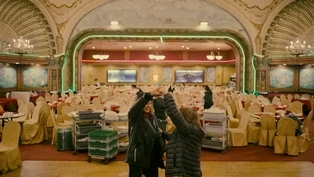
Clip: Special | 1m 30s | Cynthia Yee and Gwen Liu take viewers on a vibrant walking tour of Boston’s Historic Chinatown. (1m 30s)
Providing Support for PBS.org
Learn Moreabout PBS online sponsorship





Support for PBS provided by:
GBH Documentaries is a local public television program presented by GBH