
Kentucky Museum
Clip: Season 31 Episode 12 | 3m 34sVideo has Closed Captions
Chip Polston visits the Kentucky Museum in Bowling Green.
Chip Polston visits the Kentucky Museum in Bowling Green.
Problems playing video? | Closed Captioning Feedback
Problems playing video? | Closed Captioning Feedback
Kentucky Life is a local public television program presented by KET
You give every Kentuckian the opportunity to explore new ideas and new worlds through KET. Visit the Kentucky Life website.
Kentucky Museum
Clip: Season 31 Episode 12 | 3m 34sVideo has Closed Captions
Chip Polston visits the Kentucky Museum in Bowling Green.
Problems playing video? | Closed Captioning Feedback
How to Watch Kentucky Life
Kentucky Life is available to stream on pbs.org and the free PBS App, available on iPhone, Apple TV, Android TV, Android smartphones, Amazon Fire TV, Amazon Fire Tablet, Roku, Samsung Smart TV, and Vizio.
Providing Support for PBS.org
Learn Moreabout PBS online sponsorship[music playing] [music playing] We're having a great time here today at the Kentucky Museum on the campus of Western Kentucky University in Bowling Green.
This is Brent Bjorkman.
He's the director here.
Brent, thank you so much for letting us be here today.
It's great to have you here, Chip.
Thank you.
So, how did all this come to be?
What's the origin story of the Kentucky Museum?
In 1914, Gabriel Robertson was teaching history and found out that there was only one book about Kentucky in the library.
So, she was concerned about this and talked to Henry Hardin Cherry, who was the president at the time, and worked to get a lot of books in there.
And he got this energy about, “Let's have a museum as well.” So, by about 1928, that started this fundraising for this.
But then, of course, the Great Depression happens in 1929, which was 10 years of hard times.
The middle of the 30s, more fundraising started.
Things started to get a little bit better.
And lots of fundraising mechanisms started.
But also, the school children's funds started.
And what that was, there was a small coin bank that was distributed to kids, and they collected dimes.
And that also was part of that.
So, 4,000 Kentuckians, in some way, former fashion, helped to build this little bank.
And those little banks are so cool.
And it's great that kids were a big part of the effort.
So many places like the Kentucky Museum around the state are really going out of their way for the 250th birthday of America this year.
We're covering it a lot on our show.
Tell us what the Kentucky Museum is going to be doing.
Right.
The Semiquincentennial of America 250 is something that we've been working on for a long time.
We've been doing programming for about four years.
And it's maybe a little different than the Bicentennial that we had 50 years ago.
We're really talking about the evolution of American culture and that sort of thing.
So, we've been doing exhibits about political intrigue and food traditions of the Commonwealth, music of the Commonwealth.
So, we're really trying to expand it and showing the growth of America, how it's made different headways, and just really telling that fuller story.
And when you talk about things that you're doing along those lines, it really is part of a broader picture.
The Kentucky Museum really is a part of the Bowling Green community, aren't you?
It absolutely is.
We really pride ourselves on being what we like to call a town-gown bridge.
What does the word community mean?
We have our community, our student community, right?
And being here on campus for four years or more, you get a chance to have some experiential time here with your professors and learn some close study things, see things up close, and really bring that into the classroom.
But of course, visitors from near and far get to understand that Kentucky in general, but South-Central Kentucky is a very special place here in the Penny Rial.
And we really talk about art history and culture and how that comes together in various exhibits.
You do a great job capturing that here.
You really do.
Something I always love to ask folks in your position, whenever we're out in a great facility like this, I know it's like picking your favorite child.
But if you had one thing here that is your favorite item in the museum, what would that be?
Hard to determine, but great question.
We've been working on a sonic music exhibit about this region.
I must have to say Sam Bush's first fiddle that he was able to loan to us for the period of the run of the exhibit.
It's pretty precious and it really tells a story about somebody who is from this region and it connects internationally.
Well, it really is a great facility, Brent.
Thanks so much for sharing it with us today.
We look forward to continue to exploring today.
It's great to have you here again.
Thank you.
[music playing]
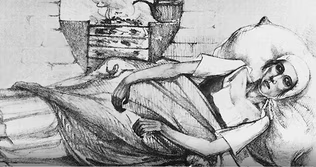
Lexington's 1833 Cholera Epidemic
Video has Closed Captions
Clip: S31 Ep12 | 4m 36s | A look back at the 1833 cholera epidemic in Lexington. (4m 36s)
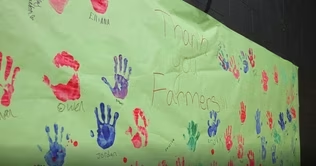
Video has Closed Captions
Clip: S31 Ep12 | 8m 2s | Jackson Independent School District -- preserving local agriculture and feeding hungry kids. (8m 2s)
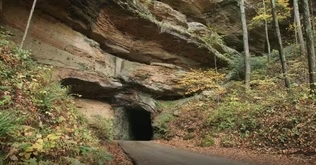
Video has Closed Captions
Clip: S31 Ep12 | 6m 46s | The history of Nada Tunnel, a former railroad tunnel and the "The Gateway to the Red River Gorge". (6m 46s)
Providing Support for PBS.org
Learn Moreabout PBS online sponsorship












Support for PBS provided by:
Kentucky Life is a local public television program presented by KET
You give every Kentuckian the opportunity to explore new ideas and new worlds through KET. Visit the Kentucky Life website.