
Queens of Combat
Season 23 Episode 3 | 55m 15sVideo has Closed Captions
Experts search for evidence that female gladiators once existed in Ancient Rome.
What if women were hidden among the ranks of Ancient Rome’s fearsome gladiators? A group of experts searches for evidence to prove women once fought in the arena just like men. Combining history, archaeology, and forensic investigation, journey across Europe in a quest for answers. If a female gladiator's existence can be proven definitively, what can we learn about their lives?
Problems playing video? | Closed Captioning Feedback
Problems playing video? | Closed Captioning Feedback
SECRETS OF THE DEAD is made possible, in part, by public television viewers.
Queens of Combat
Season 23 Episode 3 | 55m 15sVideo has Closed Captions
What if women were hidden among the ranks of Ancient Rome’s fearsome gladiators? A group of experts searches for evidence to prove women once fought in the arena just like men. Combining history, archaeology, and forensic investigation, journey across Europe in a quest for answers. If a female gladiator's existence can be proven definitively, what can we learn about their lives?
Problems playing video? | Closed Captioning Feedback
How to Watch Secrets of the Dead
Secrets of the Dead is available to stream on pbs.org and the free PBS App, available on iPhone, Apple TV, Android TV, Android smartphones, Amazon Fire TV, Amazon Fire Tablet, Roku, Samsung Smart TV, and Vizio.
Buy Now

Providing Support for PBS.org
Learn Moreabout PBS online sponsorship-Gladiators -- ancient Rome's most glorified warriors.
Even today, they are seen as fearsome men of blood and battle.
-Gladiators are celebrities, like the sports stars of today.
-With terrifying armor, menacing weapons, and bulging muscles.
they're the Roman ideal of masculinity.
But what if, hidden among their ranks, there were women?
History is dominated by men.
But lost in the backrooms of museums and hidden in ancient texts, scholars believe there could also be proof of female gladiators.
-What we need to do is a proper, intensive investigation.
-Now a hunt is under way -- an international search piecing together fragments of evidence... -I realized that I was actually looking at female gladiators.
-...to prove that women fought in Rome's mighty amphitheaters.
-Being down here makes me realize how isolating it might have been for a female gladiator.
-Could women have played a bigger part in this violent Roman spectacle than previously believed?
-Women were not frail.
They were not meek.
They were not locked away from combat.
-These women have been hidden, until now.
[ Dramatic music plays ] This is the search for ancient Rome's queens of combat.
-[ Scream ] [ Mid-tempo music plays ] -Gladiator fighting goes hand-in-hand with the Roman Empire's most iconic buildings -- amphitheaters.
♪♪ Here in southern Italy, classicist Daisy Dunn is looking into the origins of gladiatorial combat to see if women played a role.
-We are in Pozzuoli in the Bay of Naples, right near the sea, and we're standing in the most amazing amphitheater.
Pozzuoli is part of the ancient region of Campania.
And given the amount of amphitheaters in this area and the number of tomb paintings featuring gladiators, there's very good reason to believe that gladiatorial combat was born here, in this very area.
-Grand edifices of the Roman Empire still stand.
But the people who spent time inside them 2,000 years ago are harder to trace.
Frescoes found in a nearby grave date back to the 4th Century B.C.
They're thought to be the earliest known depictions of gladiators.
-The appearance of these gladiators within tombs really corroborates that the first gladiatorial fights were done in order to honor the dead.
They were part of the funeral rites.
So this is a very likely birthplace for gladiatorial combat.
-Amphitheaters became a defining feature of Rome, scattered across the vast expanse of one of history's greatest empires.
The one at Pozzuoli is the third-largest in Italy.
The mighty Colosseum is just 150 feet longer.
-The Roman Empire was a place of staggering ambition, huge ingenuity, and also had a very sort of fierce competitive spirit to it.
The amphitheater was really the most iconic symbol of Rome's empire.
The larger it became, the more important it was to define what it meant to be Roman.
And this is where amphitheaters came in useful.
-People came to the amphitheater to see bloodthirsty gladiatorial fights.
Gladiators primarily came from the ranks of the enslaved and convicts, But occasionally, members of the upper class chose to fight in the arena for glory.
-Being a gladiator was really a huge sacrifice.
You swore away your rights basically as a human being.
You agreed to be branded, to be chained up, to die at the sword.
-Despite being enslaved, a few gained wealth and celebrity.
-Gladiators could come and really exhibit a lot of the virtues that were expected in Romans.
And that was a very kind of masculine form of courage and fortitude.
-Roman historians were exclusively men.
Any surviving contemporary texts were written by men, who fixated on masculinity, recording male exploits.
Women were rarely included in the story.
-We have to be very reliant upon sources that were created by men in order to discover what women were doing and what they were like.
Being a classicist is a bit like being a detective.
You're having to make evidence work really very hard from lots of different areas, so works of literature, works of history, art, archeology.
You can find little pieces and bring them together like a jigsaw puzzle in order to work out what women were doing and how they were perceived.
[ Dramatic music plays ] -Works from historians and writers of the time must be carefully scrutinized, particularly when searching for female gladiators.
♪♪ Ancient texts turn up in the most unexpected places.
London's celebrated Westminster Abbey hides an obscure clue about women in the arena.
[ Bells tolling ] ♪♪ Professor Kathleen Coleman is an expert on ancient Roman poetry.
♪♪ She's at the abbey's library to find a manuscript which celebrates the varied wonders of amphitheaters.
-If we are trying to find out about female gladiators in the ancient world, then this book is pretty much as close as we can come to an eyewitness account.
This book here are the collected poems of Martial, who was a Roman poet who lived in the 1st Century AD.
This book is very exciting.
It's just so beautiful.
-Over the centuries, Martial's poems were copied by scholars and clerics, preserving his vivid descriptions of the Roman games.
-They comprise all sorts of different spectacles, from gladiatorial combat to aquatic displays and animal displays.
-But are there any references to women?
-There's a couplet, just two lines, which appear to be about women performing in spectacle.
And the first couplet makes a comparison between Mars, the god of war, and Venus, the goddess of love.
But both of them are wearing armor in the service of the emperor, which seems to refer to a male fighter and a female fighter.
-Here, women are mentioned appearing alongside men in the arena.
It's a tantalizing clue.
But can it be trusted?
-You can imagine how many mistakes could creep in in that time when you're copying everything by hand.
And in fact one really stupid mistake has come into this book, which is that we've got the 14 numbered books of Martial's epigrams.
And then a 15th book was added, which we know is not by Martial at all.
But obviously the person who copied the manuscript thought that it was by Martial.
-This extraordinary mistake is a reminder that written work can be misidentified, misunderstood, or even overlooked.
It's a good starting point, but the hunt for female gladiators has just begun.
-If we're on the scent of the clues that Martial gives us in this book, then we want to see if we can find other evidence to back this up, which indicate that this was a known phenomenon, a fighting woman in the ancient world.
-Martial gives a rare glimpse of a woman appearing before the amphitheater crowd, but her exact role remains unclear.
♪♪ Back in southern Italy, Daisy Dunn is also scouring ancient texts for evidence.
She's found mention of combat at Pozzuoli staged some 30 years before Martial was writing.
♪♪ -I discovered this really interesting reference in a history book by Dio Cassius, who was a Roman historian, and he describes a particular set of games.
It was put on by the Emperor Nero at Pozzuoli.
-Nero was a tyrannical and self-indulgent ruler, infamous for extravagance.
-It was a particularly important gladiatorial show in honor of the King of Armenia and his family, who were visiting Italy.
We're told that it was Ethiopian men and women and children who were fighting.
-This text was written nearly two centuries after the event, with full knowledge of Nero's excesses.
-It's possible that it was Emperor Nero showing off how far he had extended his empire.
He's saying, "Look.
I've reached Africa.
Here's the proof."
-So what was Nero doing with these women in the amphitheater?
It seems unlikely they were genuine, professionally trained gladiators.
Rather, that they were forced into the arena as a cruel form of entertainment.
♪♪ -It's sadly entirely possible that some of these Ethiopian women who'd been brought here were actually executed within the arena, which in Roman terms was still valued as an entertainment in itself.
♪♪ -Details about these women were never recorded.
-Women were not considered important enough by the people who were copying things out to keep and to pass on to the next generation.
-Women did appear in the arena at Pozzuoli, but it was likely a macabre spectacle put on by a notorious emperor.
♪♪ Meanwhile, in London, Kathleen Coleman is at the British Library, one of the greatest collections of books in the world.
She's searching for more evidence in the works of Roman satirists, who captured life in the Empire with biting humor and ridicule.
-It's the job of a satirist to be disparaging of social habits.
The difficulty with reading satire is to be able to calibrate how much veracity lies behind it.
-The famous Roman satirist Juvenal wrote during the 1st Century AD, around the same time as the poet Martial.
-Juvenal was also writing at the height of the Roman Empire, and his satires show a persistent anxiety about the sort of dilution, if you like, of Roman behavior, Roman character.
So when you get a woman adopting a male role, that would have been disturbing.
Juvenal would have felt that anything as transgressive as a female gladiator would threaten the fine, upstanding morality of the traditional Roman society.
-One of Juvenal's satires contains a section that suggests female gladiators might have existed.
-In Juvenal's sixth satire, there's quite a long passage satirizing a woman who aspires to train as a gladiator.
And Juvenal's language makes her sound really ridiculous.
He has all sorts of disparaging things to say about the way she grunts while she's doing her press-ups and so forth.
He talks about how much she makes a grunting noise, generally doing extremely unfeminine things.
And then there's this crucial line with the word "arena" in it, where Juvenal says, "And maybe she even hopes she'll actually appear in the arena as a gladiator."
-Juvenal paints a colorful picture.
But is he a reliable witness?
-A satire is by definition not objective reporting.
But if we're trying to understand the ancient world, then every single scrap of potential evidence is valuable.
And this is a piece of potential evidence.
It's potential evidence that women did aspire to train as gladiators.
-Whether or not Juvenal was writing about a real person, the prospect of a female gladiator was a reality to him and his audience.
♪♪ Archaeological evidence is needed to confirm the existence of female gladiators.
And a small museum in southern Italy might have it.
♪♪ Professor Edith Hall visits the National Museum of Campobasso.
It's home to a decree issued by the Roman Senate almost a century before Juvenal wrote his satires.
-There's actually a vast amount of evidence for female gladiators, but people haven't really understood the evidence, or they haven't been looking for the evidence because they didn't think that there were female gladiators.
-This decree isn't easy to find.
The text is not on view to the public.
The original bronze was cut up and reused hundreds of years later, and the proclamation is hidden on the back.
-Oh, here we are.
What I've got here is the back of the tablet.
This very definitely mentions women.
It very definitely mentions gladiators.
It's extremely exciting.
It starts off here that these laws are going to apply to those who "qui contra dignitatem ordinis" -- so "contrary to the dignity of their order," their class -- men and women are not allowed to offer themselves out by contract to become a gladiator.
-It's the inclusion of women that makes this ban so significant.
Women are being warned not to fight in the arena like men.
The ban reveals a deep conservative paranoia behind the words.
-There's a sense of moral panic in it to me, which tells us that there was extreme anxiety about women performing as gladiators.
Now, it could be that somebody just decided to dream up a law that they shouldn't, but I don't buy that for an instant.
The reason they're passing this law is because there's a problem.
-This decree has been dated to 19 AD, the early days of the Roman Empire.
The ruling emperor Tiberius enacted waves of strict social reforms, and the Senate had cracked down on immorality.
-Emperor Tiberius was incredibly anxious to demarcate the class difference between people of the senatorial and equestrian ranks, and the rest of people.
-His ban was not concerned with enslaved people, but the upper classes.
For an elite woman, performing in the arena would carry deep social shame and dishonor.
The penalties were severe.
Flouting the ban would lead to a total loss of her privileged status.
-As a woman, that wrecked your marriage chances completely.
To have women cavorting in the arena, you cannot have that.
You have to keep your women in order.
-This tablet shows men believed there was enough risk posed by women fighting in the arena to warrant a ban.
And the law is a compelling piece of evidence because it was contemporary and not written later.
-This is certainly the first authentic piece of evidence.
So yes, we found it.
We found the earliest evidence for female gladiators in existence.
-With the ban as evidence, female fighters must have existed.
But is there anything that shows what they looked like or how they fought?
♪♪ One researcher believes a cheap, ubiquitous Roman object could be concealing images of female gladiators.
♪♪ -If women were fighting throughout all those years, then maybe we should start looking at the evidence from a different perspective.
-Dr.
Anna Miaczewska studies everyday objects from the ancient world to gain an understanding of the ordinary people typically left out of the history books.
-I really wanted to have a closer look at things that people would use on a daily basis.
-Clay gladiator lamps were cheap and easy to produce.
There are thousands of them in museums around the world.
-The lamps were like souvenirs.
We have them everywhere throughout the entire Roman Empire.
-Images on the lamps like these at the British Museum celebrated highlights of the fights.
-One of the scenes shows a gladiator who's on his back, probably just about to be killed.
The other one here is one gladiator is running away from his opponent.
He's holding his back, so probably he's already injured, or some scholars just suggested that it's a satire, a bit of this really funny moment.
And, then, this final lamp is a gladiator who's, in a sense, it's this stance of victory.
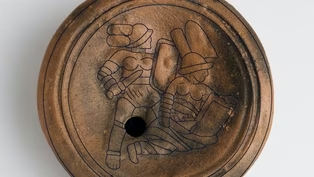
-At the Nicholson Collection in Sydney, Australia, Anna studied more than 400 gladiator lamps.
-I came across one particular lamp, oil lamp, and I thought the image was just different from anything I've ever seen before.
♪♪ So I decided to study it in more details.
So, the upper body of the two figures had attached circular shapes that were slightly protruding.
And interestingly enough, it's not only on one figure, but it was on two figures.
And, also, the circular shapes were added basically where the female chest is, actually had two figures with what we could really recognize as female breasts.
And then I realized that I was actually looking at female gladiators.
-The lamp depicts women fighting the same way men did.
-It's exactly the same scene -- one person running away and the other person just about to probably attack his opponent from the back.
And I do believe that if we have one lamp like this, perhaps in the future, we're gonna find more lamps with female gladiators on them.
-Gladiator lamps captured the interests of everyday Romans.
Perhaps these items left by ordinary people can provide the most authentic images of female fighters.
And there's one place where other authentic images might be found -- Pompeii.
♪♪ Mount Vesuvius erupted a decade after the death of Nero.
It smothered the thriving city in a blanket of ash, preserving it for millennia, Pompeii was a city obsessed with gladiators.
Illustrations of how the fighters lived and died can be found all over.
Can more evidence of female gladiators be found here?
-So, we don't have a lot of evidence, so sometimes we just have to speculate and draw on what we know from the male world.
-Archaeologist Dr.
Sophie Hay knows where to look for clues.
-This is the gladiator barracks.
There would have been a covered walkway supported by these beautiful columns.
All around this portico, we have these little, tiny cells.
And you can see the doors here.
If we look inside, we can see there's probably room for a few beds and spaces for people to live.
It's pretty stark, pretty basic.
Would have been quite cramped if there had been a few gladiators inside.
-Shackles found in the barracks indicate some were chained up.
While the Roman elite may have toyed with the romantic idea of amphitheater combat, this is how many gladiators lived.
-Most gladiators were slaves, so they were the possession of their owner, and their lives were pretty sort of awful, to be fair.
-Female gladiators would likely have been enslaved, too, possibly owned by a trainer or a wealthy aristocrat.
But despite the lack of freedom, the job still came with a degree of glory.
-Around the edge of the gladiator barracks, they found some real, proper gladiator armor.
-The armor is housed in a nearby archaeological museum.
♪♪ Would a female gladiator have worn something like this?
♪♪ Again, Pompeii may provide the answer.
♪♪ Ancient historians present sparse evidence for female gladiators, but the graffiti of ordinary Romans could offer tangible proof of how they fought.
-What really helps finding them is actually putting a light, but a raking light.
And with that, you can see all the details.
We have two figures fighting each other, and we can see the plume on top of the helmet.
This one is carrying a really long spear with a point directed towards his enemy.
It's the middle of a battle.
And this is very, very common in Pompeii, is to have two gladiators in the process of combat.
We're in a corridor that leads to the theater, and I imagine that there were queues to get in.
Perfect time to turn to the wall and draw something, write something.
All of these little traces of humans from 2,000 years ago are all here.
This is the unedited voice of the masses.
-And something more astounding lies on the other side of the corridor.
-So, here we seem to have a gladiator on their own.
We have much more detail about the shin guards, the ties around the knees.
We have the shield in there.
But we also get to see the arm coming down, holding the sort of short sword.
But the difference with this one is that the bust seems to be a little bit more exaggerated.
So is this a female gladiator or not?
To have a representation of a female gladiator would be amazing, because we have so little evidence for them, yet we know they were there.
So if this was a woman, this would be fantastic.
-The graffiti seems to depict female fighters wearing the same armor as men.
An image of what they might have looked like is beginning to emerge.
But what would female fighters experience once they entered the arena?
-The amphitheater is right on the other side of town, so there would have been a procession going towards the amphitheater on the day of the games.
You have to imagine people lining the streets to watch this procession and spot their favorite gladiator.
The women sort of were a little weak at the knees at seeing these sort of hunky men go past.
-Ancient frescoes found in an amphitheater offer an idea of what attending a gladiator fight was like.
-So, this is the oldest stone-built amphitheater in the Roman world.
So, it was built in about 70 BC.
It's enormous.
It seats about 20,000 people.
There would have been a beautiful fresco that would have covered all the internal wall of the arena.
-Over time, the elements destroyed the frescoes, but 18th-Century artists managed to capture the vivid life of the amphitheater before the paintings were lost.
-One of the gladiators is standing there while an attendant sort of straps him in his armor.
And then we have a musician.
So a lot of these games would be accompanied by music.
[ Dramatic music plays ] We have two very interesting portrayals of gladiators, and they stand like sentinels on either side of that little door.
And that is the death gate, the "Porta Libitinensis."
And this is where dead animals and potentially even dead gladiators are dragged off the arena and out to be disposed of.
And they stand there honoring the dead.
♪♪ -One Pompeii tomb reveals the amphitheater's grim order of events.
-If you came in the morning, you would more likely see an animal hunt or a procession.
And, then, the lunch break.
That's when you get crucifixions.
And, then, it would be the evening afternoon entertainment that would be the gladiators, and the battle would commence.
-And just like today, the main event was last.
[ Dramatic music plays ] Historian Alexandra Sills specializes in gladiators and Roman Britain.
♪♪ In London in the late 1990s, a Roman cemetery was found.
And one grave stood out.
-It was set apart from the rest of the burials in that cemetery.
What we do know from literature is that gladiator graves tended to be separated from the rest of the population.
-Some of the grave goods also added to the mystery.
-In this particular grave was found eight lamps.
And the lamps were particularly interesting.
One of the lamps has a gladiator who's fallen.
The immediate reaction was that the person in the grave must have been a gladiator.
-But further investigation exposed something even more unexpected about this burial.
-One of the best bones to determine sex in a skeleton is the pelvis bone.
And thankfully, just enough of that was found to be able to safely say that this skeleton belongs to a woman.
-The discovery fueled rampant speculation that the remains of a female gladiator had been found.
-Much of the excitement was about a gladiator being found in general.
So for the first gladiator to be found to be a woman would have been truly incredible.
-But there's not enough evidence to be sure.
-I'm inclined to believe that she was a gladiator fan.
-Today, Alexandra is clear about where the inquiry should go next.
-So, since the discovery of the skeleton, we've learned more about gladiatorial combat and its ideology.
So we're going to hopefully move away from the idea of gladiators as bloodthirsty brutes who hack at each other until nearly everyone's dead and understand this as a performance of martial excellence, of skill.
♪♪ -Perhaps there is evidence of this evolution of gladiator fights that includes women.
♪♪ Dr.
Alfonso Mañas wants to find definitive proof of what female gladiators looked like by re-examining evidence from the field of athletics.
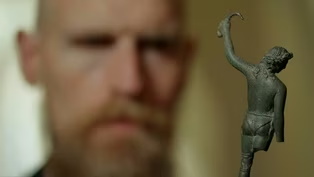
♪♪ In a museum in Hamburg, Germany, he noticed a 2,000-year-old statuette that curators had identified as an athlete.
But he wasn't so sure.
♪♪ -It has been interpreted as a woman making some kind of athletics.
But this is impossible if you make a close examination of the statuette.
-Female athletes were a world apart from gladiators and weren't outcast in the same way.
Athletics was a leisure activity.
Being a gladiator was a notorious profession.
Alfonso uses high-resolution imagery to assess whether this statuette has been mislabeled.
-It's a very special moment for me to be able to examine her and all the details.
-Her clothing signals she can't be an athlete.
-Female athletes typically wear a tunic.
In this case, we don't see any tunic, so she is not an athlete.
Many gladiators fought with a loincloth, and female gladiators adopted that same clothing.
And very important is the knee bandages.
Athletes are never depicted with knee bandages.
However, the knee bandages are very useful in gladiators.
-The statuette wears the outfit of a gladiator, not an athlete.
But that's not all.
Previously, curators had thought the item in her hand was a cleaning tool used by Roman athletes.
But Alfonso's investigation proves it's a deadly weapon.
-That is clearly a sword.
We can see the ball at the back of the handle, typical of Roman sword.
We have a flat hand protection on top, like in the sword.
And then we have the blade.
It's possible that the blade has been bent by an accident.
So maybe originally, it was straight.
-And the statuette's pose mirrors that of her male counterparts.
-This is the victory position.
This is how gladiator fights ended.
He raised his hand with a sword on top, saying, "Okay, I am the winner, and this is my victory position."
-The victorious fighter looks to her rival on the ground.
-For me, there is no doubt that she's a gladiator.
-Hiding in plain sight for more than a century, she's the only statue of a female gladiator found so far.
And it's clear from this statuette that female fighters acted just like their male peers.
But can anything be said about the lives they led?
♪♪ -I spent most of my career researching the lives of women in ancient Greece and ancient Rome, and I know from looking at the sources that they are the hardest to find.
I really want to know who these women were.
I want to know why were they in the arena in the first place?
What were they doing when they were actually here?
How were they perceived?
Were they feared, these women?
I want to find out.
-The frozen-in-time world of Pompeii is the best place to do this.
♪♪ Any records about the lives of the ordinary Roman women who might have fought in the amphitheater have all but vanished from history.
♪♪ Sophie Hay knows that this preserved city offers a rare window into the female world, one that might provide not just images, but also names.
-From a woman's perspective.
what Pompeii gives us is this sort of unfiltered look at what women could be doing in a city like Pompeii.
-Sophie has studied one unique property.
A painted sign reveals that it was owned by a woman -- Julia Felix.
Julia's house offers a very different view of Roman women.
-All the way around the top level of this wall would have been a fresco from the Forum market scene.
There are people holding up pieces of textiles, someone selling pots and pans.
The women are the buyers.
They are purchasing.
This gives them agency.
This means that these women are actually going out and partaking in society.
Men saw women as either sort of domestic goddesses or prostitutes, and there seems to be a little bit of a lack of stories of people in between.
But here in Pompeii, we get this, you know, complete spectrum of the role of women.
-Without the eruption, Julia's existence might never have come to light.
But what about less fortunate women?
A house on the other side of Pompeii exposes the harsh reality that may have forced women into the ring.
♪♪ -As you walk through its entrance, it's all about opulence and showing off.
Meanwhile, one door to the side, you go through that, and suddenly there's no decoration.
The rooms become small, dark.
And this is where the female slaves would essentially be -- cooking, cleaning.
And as you come in, in the entrance, someone has scratched the name of a Greek woman -- Eutychus.
It says that she's smooth and gentle and you can buy her for the same amount as a cup of wine.
And linked to that is a small room which has erotic paintings on the wall.
But why is this right next to the kitchen?
Is this where Eutychus works?
We don't know.
But essentially, you can buy her, and potentially, you could use her services in this room.
-For women like Eutychus, the amphitheater may have offered a different life.
-I think women, if they were in a very difficult position, they would turn to the possible options.
One of them was prostitution.
But if they let's say were strong, or if they thought that they would be ready to fight, perhaps they were forced to really become gladiators.
-Would female gladiators have lived in the Pompeii barracks?
[ Dramatic music plays ] When Vesuvius erupted, few people were safe from the scalding ash that engulfed the city.
The dreaded cells of the gladiator barracks seemed to offer crucial refuge.
-We have Vesuvius there.
And essentially, the volcanic material is coming towards Pompeii in this direction.
People would have been fleeing what was coming towards them.
And this would have been the furthest point within the city they could get.
It must have been horrific.
So these little cells would be the perfect hiding space.
They would feel secure.
♪♪ But eventually, they'd be trapped in these rooms and wouldn't be able to escape.
So the place that they thought was going to protect them actually became their tomb.
♪♪ -Evidence of the victims is a chilling sight visible all over Pompeii.
♪♪ And skeletons were found in a cell at the gladiator barracks.
One belonged to a woman, and she was clutching invaluable items.
Could this unlikely wealth identify her as a gladiator?
♪♪ At the Archaeological Museum of Naples, Floriana Miele is custodian of the priceless artifacts.
♪♪ -One of the skeletons carried with her various pieces of jewelry.
In particular, four bracelets were found and two rings with gemstones.
-One with an Egyptian emerald and another with a garnet engraved with a chariot.
-So when you put it all together, this jewelry suggests she might have been a lady of high social status and great economic means.
♪♪ -Some male gladiators accrued great wealth and gained their freedom.
Why not women?
Given the location of the skeleton, perhaps these were the spoils of a woman who trained in the barracks and fought as a gladiator.
-It would be great to think she was a female gladiator.
She is a woman, she had jewelry on her, and she was found in the gladiator barracks.
But that's not enough to say she was a gladiator.
-With no confirmed identity of a female fighter in Pompeii, the search for the name of a woman fighting in an arena moves behind the scenes.
♪♪ A potential breakthrough lies hidden in the Apennine Mountains, south of Rome, in the remote abbey of Monte Cassino.
♪♪ Edith Hall is an expert in ancient spectacles and public performance.
She knows that when power shifted toward Christianity, the Church became custodian of many of the empire's relics, including inscribed artifacts brought in by locals, who had unearthed them in their fields.
-Every town in Roman Italy had inscriptions.
The local people will pretty automatically have brought inscriptions to the monks, because they were literate, and they understood Latin, and they understood Greek.
-Hidden from public view, the vaults of the abbey contain hundreds of Roman inscriptions, from gravestones to public decrees.
One catches Edith's eye.
-Here we have a massive inscription, and it's very beautiful.
The lettering has been done with very great care, and it's very big.
-Amazingly, this magnificent inscription is written in celebration of a woman.
-The translation of that is "Ummidia" -- biggest letters "-- Quadratilla" -- that's her full name "-- built the amphitheater and the temple for the people of Cassina with her money."
So here we have the first named woman in connection with an amphitheater in any of the ancient evidence.
It's incredibly exciting.
It's a woman called Ummidia Quadratilla.
What she's doing here is telling everybody she is the benefactress of the city.
And I feel a real bond with her because I've actually named her.
She is Ummidia Quadratilla.
-Edith deepens her search to find out whether Ummidia had a direct connection to female gladiators.
-So, this magnificent amphitheater is the very one that Ummidia Quadratilla funded at some point in the 1st Century AD.
And the most likely site of the inscription was the large passageway there where the light is coming in.
There were amphitheaters like this all across the Roman Empire, but as far as we know, very few, if any others, were actually funded by a woman.
-Having a full name is invaluable.
-So, as a classical scholar, when I see proper names, I can go off to a library and look for her in other sources.
-And unusually for a woman, there are written records of her life.
-We've got a letter by the Roman author Pliny.
He says that she lived to a very ripe old age for that time.
She was very nearly 80.
And he says she remained in robust and rude health all the way to her death.
She was a local aristocrat, the daughter of the Roman governor of Syria, and it was possible for him to make a very great fortune, which she inherited.
Pliny also tells us she actually had her own troupe of pantomime dancers.
-Pantomime was performed in amphitheaters.
A single actor mimed and danced all the roles in a play.
-Actually, the distinction between a big gladiatorial combat and a performance of pantomime is very, very blurry.
For example, when gladiators died in the arena, we know that an actor came in dressed as Mercury, because Mercury was the God who took the souls of the dead down to Hades.
That was nothing to do with being a gladiator.
That was being an actor.
-Gladiator armor illustrates the connection between the stage, arena, and women.
-Gladiatorial helmets often had full-face visors that were sculpted in metal to look very like a pantomime mask.
Now this is an authentic replica of an ancient pantomime mask.
It's of the goddess Minerva to the Romans, Athena to the Greeks.
Some characters in myth are more likely to have appeared as sort of adjuncts in gladiatorial spectacles.
Actually, Minerva was likely to, because she was a warrior goddess.
-Ummidia's story shows that women could exert influence over events in the amphitheater, whether they were fighting or not.
-I think it's highly likely that Ummidia had dealings with gladiators.
In fact, I think it would have been impossible for her not to have done.
Whether she ever had any direct dealings with women gladiators, we don't have any evidence for that, but I think it's pretty likely.
One of the reasons for that is that there are those pantomime elements within gladiatorial spectacles.
-Ummidia lived during the excesses of Emperor Nero's reign, when perhaps it was more acceptable for women to participate in public spectacles.
Later emperors like Trajan favored morality and discipline.
Could that have had an impact on this modern-day search for the queens of combat?
[ Blades clanging, crowd cheering ] ♪♪ At the British Library in London.
Kathleen Coleman returns to the works of the satirist Juvenal.
He was a strong critic of any immorality he saw in Roman society and focused his attention on people he believed were weakening traditional Roman ideals.
-I'm very interested in the two lines in the early part of "Satire 1," in which there seems to be an allusion to a female fighter in a spectacle.
And there's certainly a sneer of horror in his voice.
He mentions a woman who skewers a boar from Etruria.
They were notoriously fierce.
This is valuable as evidence, because we have no other definite evidence for a woman fighting an animal.
-And there's more.
For the first and only time, a female fighter is mentioned by her actual name.
-Juvenal mentions a woman with a personal name, Mevia.
That's a key piece of evidence for us, because it gives us the name of a woman actually fighting in a spectacle context.
-Finally, a name -- Mevia.
She went head-to-head with vicious, wild boars in the arena.
Back on the ground, Daisy Dunn follows Juvenal's lead and investigates the possibility of a female beast hunter like Mevia fighting in Pozzuoli's amphitheater.
-We don't know which amphitheater Mevia actually fought in, but we have to imagine her fighting in an arena just like this one.
This amphitheater would have seated about 40,000 to 60,000 people.
-Pozzuoli would have hosted beast hunts, just like Rome.
Daisy meets local archaeologist Fabio Pagano to find out more.
-Do you think that a lot of the animals who are coming to fight would have come directly from abroad, across the sea to this port?
-Yeah, yeah, sure.
Because Pozzuoli -- So, it's the most important harbor in western Mediterranean.
So probably the people love very much to have this kind of show with strange animals, like lions, like elephants, like rhinoceros.
-Mevia's ordeal likely started beneath the amphitheater.
-This is the underground sector, so as we imagine something like the backstage of a theater.
-Beast hunters would have prepared here, bracing for the fearsome encounter ahead.
-Being down here makes me realize how isolating it would have been for a female beast hunter like Mevia.
She'd have been confronted by cages of wild animals.
The noise, the smell -- it must have been totally overwhelming.
-This underground area is known as the hypogeum.
-So, the hypogeum at Pozzuoli is one of the most elaborate that survives across the Roman world.
-Both animals and fighters like Mevia were brought to the ring by an intricate lift system.
-By pulling them up, raising them through the trap doors they'd have been taking people completely by surprise.
The people who are sitting in this arena would have been absolutely stunned to see her enter.
Female beast hunters were relatively rare.
The sheer sort of exoticism of having a woman there with a spear and an animal would have won her over to the rest of the crowd.
-Mevia was a beast hunter -- a type of fighter closely associated with gladiators.
But they did not fight other people.
The goal remains to find evidence of a fight between two female gladiators.
♪♪ In London, Kathleen Coleman hopes the British Museum holds what she's looking for.
-In the British Museum, in this gallery of Roman life, we have largely artifacts to do with male activities.
And that is simply the record from antiquity.
-Kathleen firmly believes that one object is different.
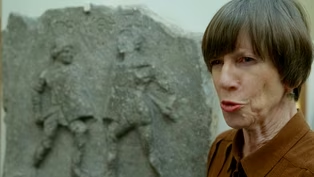
-What we're looking at here is a stone relief given to the British Museum in the 1840s.
And we see two figures here in combat.
These two figures look female.
The one on the left has a feminine-looking hairstyle, and there's one breast bared.
But there's one other thing on this relief which clinches it, and that is the inscription at the bottom, which gives us their names.
And they're both feminine names.
The names are Amazon and Achillea.
And these are clearly their professional names as fighters, because names from Greek mythology are very common as gladiators' professional names.
♪♪ -Much like modern-day wrestlers, the women in the relief adopted stage names, reinforcing their warrior personas.
-Both the women are in combat stance, facing one another with their weapons at the ready.
So there's nothing wimpish about these women.
This is a serious representation of two gladiators.
There's nothing that makes it look like a parody.
So these two figures are kitted out as regular gladiators would be if they were male.
They have a big, curved body shield they're each carrying and a straight sword in their sword hand.
-But one piece of protection is not being worn.
-These two combatants are not wearing a helmet.
That is a typical gesture for acknowledging that you have not fought to a conclusive victory.
You take off your helmet.
-It's not combat simply for the sake of violence, but as a choreographed display of power, skill, and spectacle.
This marble relief is the single greatest monument to female gladiators ever discovered -- two named women fighting not to the death, but to a draw, with armor matching that of men -- female gladiators holding their own alongside their male counterparts.
[ Blades clanging ] ♪♪ The evidence uncovered has restored women to their rightful place as queens of combat.
But the hunt to find out more about them continues.
More stories may be out there waiting to be discovered.
-The history of humankind is a history of men.
And women are there, but they're never the most important element.
-We have actually a moral obligation to seek out those women, to try and show some interest in them, to try and discover what they were like, what they were doing.
-It's so hard to say where evidence might come from.
It can come from the last place you look.
This is the prime location where we might find such evidence.
We just have to keep looking.
An Everyday Roman Object Suggests Female Gladiators
Video has Closed Captions
Clip: S23 Ep3 | 2m 59s | A Roman oil lamp shows two female gladiators fighting like men—strong visual proof women fought. (2m 59s)
New Analysis Changes the Identity of a Roman Statue
Video has Closed Captions
Clip: S23 Ep3 | 3m 2s | Once thought an athlete, this Roman statuette may depict a female gladiator in combat pose. (3m 2s)
The Only Relief of Named Female Gladiators Ever Found
Video has Closed Captions
Clip: S23 Ep3 | 2m 39s | This rare depiction may be the greatest surviving monument to women in the Roman arena. (2m 39s)
Video has Closed Captions
Preview: S23 Ep3 | 32s | Experts search for evidence that female gladiators once existed in Ancient Rome. (32s)

A Roman Poet’s Clue to Women Gladiators in the Arena
Video has Closed Captions
Clip: S23 Ep3 | 2m 34s | Martial described gladiatorial combat and hinted women fought—but can hand-copied texts be trusted? (2m 34s)
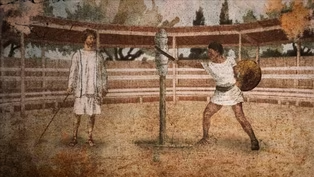
A Roman Satirist Mocked Female Fighters. Was He Describing Real Gladiators?
Video has Closed Captions
Clip: S23 Ep3 | 2m 22s | Did Juvenal’s mockery prove female gladiators existed? (2m 22s)

This Roman Law May Be Proof of Female Gladiators
Video has Closed Captions
Clip: S23 Ep3 | 2m 54s | The ban hints at moral panic, and possibly the clearest proof that female gladiators truly existed. (2m 54s)
Providing Support for PBS.org
Learn Moreabout PBS online sponsorship















Support for PBS provided by:
SECRETS OF THE DEAD is made possible, in part, by public television viewers.