
October 5, 2026 - PBS News Hour full episode
10/5/2026 | 57m 46sVideo has Closed Captions
October 5, 2026 - PBS News Hour full episode
October 5, 2026 - PBS News Hour full episode
Problems playing video? | Closed Captioning Feedback
Problems playing video? | Closed Captioning Feedback
Major corporate funding for the PBS News Hour is provided by BDO, BNSF, Consumer Cellular, American Cruise Lines, and Raymond James. Funding for the PBS NewsHour Weekend is provided by...
October 5, 2026 - PBS News Hour full episode
10/5/2026 | 57m 46sVideo has Closed Captions
October 5, 2026 - PBS News Hour full episode
Problems playing video? | Closed Captioning Feedback
Where to Watch PBS News Hour
PBS News Hour is available to stream on pbs.org and the PBS app.
Providing Support for PBS.org
Learn Moreabout PBS online sponsorshipGEOFF BENNETT: Good evening.
I'm Geoff Bennett.
Amna Nawaz is away.
On the "NewsHour" tonight: The U.S.
Supreme Court kicks off another term with arguments on whether energy companies can be held liable for climate change.
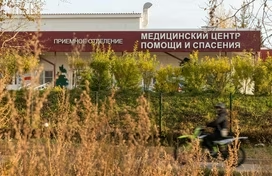
A technician at a Russian lab dies of what is suspected to be pneumonic plague, putting health officials around the world on alert.
ANNIE JACOBSEN, Author, "Biological War: A Scenario": I think what's kind of alarming is not just what happened, but the fact that now you have a situation where you have the Russian Federation working very hard to close down all information about this.
GEOFF BENNETT: And we launch a deep dive into GLP-1's, the weight loss drugs that have exploded in popularity.
JULIA BELLUZ, Co-Author, "Food Intelligence": We're just at the beginning of the great GLP-1 experiment.
(BREAK) GEOFF BENNETT: Welcome to the "News Hour."
A new term at the U.S.
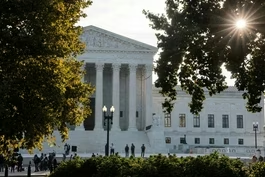
Supreme Court kicked off today as justices heard arguments in a major climate change case.
The outcome could shape how other communities hold industries accountable.
Our justice correspondent, Ali Rogin, starts us off.
ALI ROGIN: Jeff, local officials in Boulder, Colorado, are seeking compensation from energy companies Suncor and ExxonMobil for the cost of natural disasters they say are caused by climate change.
But energy companies argue they are not liable, and dozens of similar legal cases across the country could bankrupt the industry and hurt consumers.
Only eight justices heard the case after Justice Samuel Alito recused himself because of his oil and gas stock holdings.
For more on today's arguments and what lies ahead this term, I'm now joined by "News Hour" Supreme Court analyst and SCOTUSblog co-founder Amy Howe.
Welcome back, Amy.
AMY HOWE: Thanks for having me.
ALI ROGIN: Amy, prior to today's arguments, there is an expectation that the conservative judges on the court were going to rule against Boulder.
What's your take on everything after hearing the arguments today?
AMY HOWE: It was hard to read exactly how the court was going to decide this.
There didn't seem to be necessarily a majority coalescing around one legal theory in favor of the energy companies in this case.
A couple of the conservative justices expressed concern about the possibility that ruling for Boulder, the city and county that brought this particular lawsuit, would open the floodgates to similar lawsuits.
Involving climate change, but maybe even involving other causes of action around the country.
So we may just have to wait until some time early next year to see how the justices rule.
ALI ROGIN: And, as we mentioned, Justice Alito recused himself, which means it could be a split 4-4 decision.
But what does the absence of an important conservative justice here mean for the potential outcome?
AMY HOWE: It really does change the dynamic, because, as you said, it leaves them with eight justices.
If they split 4-4, that leaves the lower court's ruling in place.
And,in this case, the Colorado Supreme Court said that Boulder's lawsuit against these two energy companies could go forward.
And so a couple of terms ago, we saw in a case involving an Oklahoma religious charter school Justice Amy Coney Barrett was recused.
The justices split 4-4, leaving the decision against the religious charter school in place.
ALI ROGIN: Wow.
And if the court ends up siding against Boulder, what does that mean for other lawsuits against industries that create pollution?
Does it mean they're all kind of not going any further?
AMY HOWE: It depends on exactly what the court says, obviously, but there are -- as Kannon Shanmugam, who represented the energy companies today at the Supreme Court, said, there are more than two dozen cases around the country right now relying on similar theories to what Boulder has brought in this case, the idea that the energy companies were deceptive in their marketing and in their sales of fossil fuels.
And to the extent that the Supreme Court says that Boulder's claims can't go forward, it would mean that those can't as well.
And that was part of the argument that Shanmugam made at the Supreme Court today, was that we're not really just talking about this case.
We're talking about lots of others and potentially billions of dollars of damages around the country.
ALI ROGIN: Today's arguments were the first of the term, but there's going to be many others.
What else are you watching, listening?
AMY HOWE: So, the court will hear arguments in December in a case involving challenges to bans in Connecticut and Cook County, Illinois, on AR-15s, semiautomatic rifles.
That's certainly going to be one of the big cases of the term.
There are 16 million semiautomatic rifles in people's ownership in the United States.
And so the question is whether or not state and local governments can ban them.
There is going to be a couple of cases involving immigration, which we used to think of as a rather technical area of the law, but the Trump administration has made it really part of its policy agenda in this second term.
So there's a case involving the propriety of what we call third-country removals, rapidly deporting noncitizens to countries from which -- to which they don't necessarily have any connection and where they say they may face human rights abuses.
And then there's another immigration case that the court agreed to take up just last week involving whether or not the Trump administration can hold noncitizens who entered the country illegally and then are apprehended in detention without the possibility for a hearing to evaluate whether they could be released on bond while they await deportation proceedings.
And that is a turnabout from earlier administration's policies and could affect potentially millions of noncitizens who are in this country without documentation.
ALI ROGIN: Amy, it's a new term, but these justices didn't really have much of a recess.
They were ruling over the summer on these emergency docket cases, which are a little more rapid-fire.
They're not fully briefed or argued.
And they included some judgments on things important to the president, like the construction of a White House ballroom, mail-in voting, immigration policy.
And some of these decisions went against President Trump, and he really lashed out against the justices on the court that he appointed.
Samuel Alito was asked about this in a recent interview, and we want to play what he said.
SAMUEL ALITO, U.S.
Supreme Court Associate Justice: Criticism of the court by President Biden and justices by President Biden and his administration was very harsh.
And President Trump has been very harsh.
We are not part of any political movement.
And we are not attempting to further any political agenda.
We are trying to interpret the Constitution as best we can and apply it in the cases that come before us.
ALI ROGIN: So we know some of what's on the docket now.
Are there other issues that could come before this court that really matter to this president?
And Justice Alito kind of dismissed some of that criticism, said he takes it in stride.
But I do wonder, what's your sense of how these justices are thinking about this president's antagonism against them?
AMY HOWE: Well, I think that as far as -- I think they would all tell you that they take it in stride, that that's part of the job.
I mean, I think it's certainly unusual for the president to be so critical of the justices whom he appointed.
On the other hand, I would say that he has been highly successful.
Certainly, these were losses on the emergency docket over the summer, but there was a stretch last year on the emergency docket in which the Trump administration won something like two dozen times in a row.
And, as far as things that I'm looking for, potential issues important to the Trump administration that could come before the Supreme Court, the Supreme Court has only filled about half of its docket for the 2026-2027 term.
They will continue to add cases at least through January.
And the Supreme Court could take up cases involving the Trump administration's ban on transgender members of the military.
There's a very technical, but important set of disputes involving the Trump administration's efforts to appoint acting U.S.
attorneys in different jurisdictions around the country.
And not involving the Trump administration, but certainly something that we're all keeping our eye on is a pair of challenges to the laws in Texas and Louisiana requiring public school classrooms to post copies of the Ten Commandments.
ALI ROGIN: A very busy term.
Amy Howe with SCOTUSblog, thank you so much.
AMY HOWE: Thanks for having me.
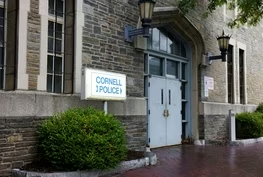
GEOFF BENNETT: In the day's other headlines: Students at Cornell are protesting the university's handling of an alleged sexual assault at a fraternity house in 2024 and to show support for the unnamed accuser.
SAYA TAYLOR, Cornell University Student: Jane Doe deserved a campus that supported her.
Jane Doe deserved an administration that delivered a fair and proper judicial process.
GEOFF BENNETT: Hundreds gathered to hear speeches by their fellow students in what's expected to be the first of multiple protests this week.
Also today, the university had to scrub graffiti blasting the school's response off its main administration building.
A Cornell spokesperson says the vandalism is under investigation.
The case has drawn intense national scrutiny since the accuser's lawsuit came to light last month.
The seven men she's accused have denied any wrongdoing.
President Trump said today that a threat linked to Iran was the reason the U.S.
withdrew its bombers from the Fairford air base in the U.K.
On Sunday, the Pentagon rushed to move a dozen B-1 bombers back to the U.S.
The long-range warplanes have been used to strike Iran.
Today, Secretary of State Marco Rubio said it's -- quote -- "not unusual" to see such rotations of aircraft, while Vice President J.D.
Vance said the U.S.
is being extremely cautious.
J.D.
VANCE, Vice President of the United States: What you saw there is the secretary of war, out of an abundance of caution, trying to protect our guys.
We do feel with some confidence that the Iranians are -- they're trying to do what the Iranian state has done for 49 years, which is engage in acts of terrorism against the United States and against a lot of other people as well.
GEOFF BENNETT: Last week, the British prime minister also said the U.K.
believes that Iran played a part in a security incident at the air base last month.
Tehran has denied any involvement.
Government forces in Yemen say they have started a major offensive against Iran-backed Houthi militants.
They claim to have recaptured several key areas along the country's Red Sea coast, including the vital port of Mokha.
The Houthis had captured the city last month as part of an effort to control the Bab al-Mandab Strait, an alternative shipping route to the Strait of Hormuz that has been slowed by the war with Iran.
The Houthis themselves claim their own advances near the city of Taiz with strikes like this one, as fighting rages on along several fronts.
In Brazil, the presidential election is heading to a run-off after neither major candidate won the majority needed for an outright victory.
Flavio Bolsonaro outperformed most polls by winning around 47 percent of the vote, compared to the 45 percent that went for current President Luiz Inacio Lula da Silva.
Analysts say that 80-year-old Lula is facing an uphill battle against the 45-year-old Bolsonaro, who's an ally of President Trump and the son of Brazil's former right-wing leader Jair Bolsonaro.
Both candidates spoke to their supporters last night and vowed to keep fighting.
FLAVIO BOLSONARO, Brazilian Presidential Candidate (through translator): I'm very happy with the result we just saw, almost 56 million Brazilians voting for me.
I could not be more pleased to see that Brazil wants change.
That's what I take from today.
LUIZ INACIO LULA DA SILVA, Brazilian President (through translator): The result is often unexpected.
I confess to you that I was convinced I was going to win the election in the first round.
But we have the second round, and the run-off is the moment of truth.
GEOFF BENNETT: The winner of Brazil's first round of voting has never lost an election, though this result was closer than others.
The run-off will take place on October 25.
Dennis Hastert, the disgraced former House speaker who later went to prison, has died.
Hastert represented Illinois in Congress for two decades.
As the longest-serving Republican House speaker, he was essential in advancing then-President George W. Bush's legislative agenda.
After leaving office, he pleaded guilty to evading banking regulations related to hush money payments.
Prosecutors say he sexually abused teen athletes while coaching high school wrestling decades earlier.
And, in 2016, he was sentenced to 15 months in prison.
An Illinois coroner's office said Hastert died of natural causes over the weekend.
He was 84 years old.
On Wall Street today, stocks edged higher to start the week.
The Dow Jones industrial average added nearly 100 points.
The Nasdaq jumped more than 1 percent to a new record.
The S&P 500 also posted a solid game.
And the 2026 Nobel Prize in Medicine was awarded to three scientists who used light to reveal the mysteries of the brain.
Karl Deisseroth, Peter Hegemann, and Georg Nagel pioneered the field of optogenetics, a technique that uses tiny lights to activate neurons in the brain.
The Nobel Committee said the tool is ushering in a new era in neuroscience.
The practice is already being used to develop possible treatments for conditions like blindness, addiction, and dementia.
Deisseroth said his work could lead to both scientific and clinical breakthroughs.
KARL DEISSEROTH, Winner, Nobel Prize in Medicine: I care about the hope that this brings, but I'm also basic scientists, and I care about understanding this amazing organ, the brain and how it works and how it integrates and computes and delivers all the things that make us human.
GEOFF BENNETT: Today's award kicks off a week of Nobel Prize announcements.
The prize in physics will be given out tomorrow.
Still to come on the "News Hour": a Marine's arrest for murder in Japan fuels an ongoing debate over the U.S.
military presence there; Tamara Keith and Amy Walter weigh in on the latest political headlines; and a new biography traces the first American pope's journey from Chicago to the Vatican.
The U.S.
says it's closely monitoring a potential case of pneumonic plague in Russia after a laboratory worker who studied the disease fell ill and died.
Russian authorities say the worker died from pneumonia of an unknown cause and insist there is no cause for alarm.
But Russian officials have also imposed quarantines and other anti-epidemic measures at several medical facilities in Siberia, with at least 200 people now under medical observation.
There is no confirmation the worker contracted plague, but she worked at a research facility that studies the disease, raising questions about what she may have been exposed to and whether there is any risk of a wider outbreak.
President Trump was asked about those concerns as he left the White House this afternoon.
QUESTION: What is the U.S.
going to do about the risk of pneumonic plague coming from Russia?
DONALD TRUMP, President of the United States: Well, we're looking at it very strongly.
We just heard about it.
And they call it pneumonia.
And pneumonia, years ago, you could treat pneumonia easier.
The microbes and the germs have gotten stronger, disproportionately, but we will help them.
GEOFF BENNETT: For more, we're joined now by investigative journalist Annie Jacobsen, author of "Biological War: A Scenario."
Annie, thank you for being with us.
You wrote an entire book about a biological crisis involving pneumonic plague.
When this story first broke, what did you make of it?
ANNIE JACOBSEN, Author, "Biological War: A Scenario": I mean, I was sort of shocked-not shocked.
Look, the idea about a lab accident causing an epidemic or a pandemic is based on real facts.
It's also based on experience.
So I think what's kind of alarming is not just what happened, but the fact that now you have a situation where you have the Russian Federation working very hard to close down all information about this.
GEOFF BENNETT: So, separate what we know from what we don't.
What has actually been established about this worker's illness and death and what remains speculative?
ANNIE JACOBSEN: Well, she's dead.
That's for sure.
What we don't know is what's going on with the 200 other people who are allegedly quarantined, or any of the other people in the five facilities that are also under quarantine.
I think, once we have some information about that, it'll be much clearer about if this is a transmissible variant, if other people are dying.
But, again, because we're getting nothing from the Russian Federation, after, by the way, a very strong initial clamp down -- FSB was involved.
That's no small thing.
GEOFF BENNETT: Is there anything about the response itself, the quarantines, the medical observation, the involvement of Russia's top public health officials, that tell you something about what Russian authorities might be worried about?
ANNIE JACOBSEN: Well, what they're worried about is that there -- this is an Anti-Plague Institute, so they're supposed to be studying medical countermeasures to plague, like vaccines, antibiotics.
But this particular institute, we know from Soviet defector scientists, was used for biological weapons engineering during their illegal program.
We also know the State Department believes that that illegal biological weapons program has continued.
And so what they're really worried about is eyes on this facility, both from the intelligence community here in the United States and the military community, looking at that facility and being like, what is going on?
I mean, look, the facility is -- has six-foot-high fences around it.
It's got concertina wire on top of that.
It's controlled in and out.
The idea that this worker broke a test tube and suddenly contracted pneumonic plague, which is inhalation plague, that does not entirely add up for somebody like me.
What I would be most concerned about is that they're kind of -- one idea is that they could be milling the pathogen, making it aerosolized.
That gets you right into the world of biological weapons engineering.
GEOFF BENNETT: What power, if any, does the WHO, the World Health Organization, have here, or does it depend entirely on Russia's willingness to cooperate?
ANNIE JACOBSEN: The latter.
It depends entirely on Russia's ability or willingness to cooperate.
Moscow shut down its WHO office during the Ukraine war, the beginning of it.
So it is my understanding that the WHO has reached out to Russian health officials and asked for information and that they have not gotten any.
GEOFF BENNETT: Is the pneumonic plague as transmissible as, say, COVID?
ANNIE JACOBSEN: Well, that's the question.
I mean, Mother Nature's pneumonic plague, no.
COVID was airborne.
It was aerosolized.
You could catch it in the air if you were in the room with someone that had COVID.
Pneumonic plague, again, Mother Nature's variant, that is pneumonic plague in the wild, is what's called droplet-transmissible.
So, excuse the graphics here, but you have to actually like kind of spit on someone or cough loudly at them.
And you would also have to be very sick to be doing that, which would make the likelihood of your close proximity without some kind of PPE unusual.
But if genetic modifications are going on, all bets are off as to how transmissible it could potentially be.
GEOFF BENNETT: And, of course, COVID exposed just how costly a lack of transparency and cooperation among governments can be in the early stages of an outbreak.
Do we have any better mechanisms today of, I guess, in this case it would be forcing countries to be transparent and cooperate to stem an outbreak before it starts?
ANNIE JACOBSEN: And that is, of course, the most important question and the most important point, by all means.
I mean, transparency is going to be the way forward or should be the way forward, because the more we know about an outbreak, the more countries can prepare to mitigate the threat, in essence.
But, again, Russia is absolutely -- not only are they not saying anything.
They're actually backtracking, and they also have really clamped down apparently on the journalists who were originally doing great reporting on the ground about quarantines.
Those people have gone completely silent.
GEOFF BENNETT: Journalist and author Annie Jacobsen.
The latest book is "Biological War: A Scenario."
Thank you for your sharing your insights and reporting with us.
We appreciate it.
ANNIE JACOBSEN: Thank you for having me.
GEOFF BENNETT: A U.S.
Marine has been arrested in Japan on suspicion of robbing and murdering a woman, putting renewed pressure on an already sensitive U.S.-Japan military relationship.
Authorities are holding 20-year-old Lance Corporal Devin Ballard in the capital of Japan's Southern Okinawa Islands, where he was stationed.
Police found the body of a 39-year-old Okinawan woman at a hotel.
Japanese media reports say surveillance footage showed Ballard entering the hotel with the victim on Saturday and coming out alone.
The Japanese government has lodged a complaint with the U.S.
government and is demanding full cooperation with the investigation.
From Okinawa, special correspondent Patrick Fok explains how the case threatens to revive longstanding tensions over America's military presence in Okinawa, seen as one of America's most critical strategic outposts in Asia.
PATRICK FOK: Gone but not forgotten.
Okinawa native Takemasa Kinjo was in his final year of high school when his mother was murdered by a U.S.
Marine in their home more than 50 years ago.
TAKEMASA KINJO, Anti-Base Activist (through translator): Teachers had told us that something like this could happen to anyone.
But when my mother became a victim, I never imagined it would happen to my own family.
PATRICK FOK: Now, with the arrest of serviceman Devin Ballard over the alleged killing of a local woman, Kinjo says it shows the problems with the U.S.
military presence in Okinawa never went away.
TAKEMASA KINJO (through translator): The anger's really taken hold.
Now it's happening again.
I just can't forgive it.
Will it ever stop?
PATRICK FOK: U.S.
forces have been on this island for more than 80 years since the bloody Battle of Okinawa in 1945.
For the nearly 30 years that followed, the island was under direct U.S.
military rule.
During that time, it became a major hub for American forces in the region.
When the island was handed back to Japan in 1972, much of the U.S.
military presence stayed.
Today, Okinawa remains home to the vast majority of America's military bases in Japan.
But, for years, that heavy presence here has fueled local outrage tied to a long history of military accidents and high-profile crimes.
This latest case is testing Tokyo's ability to manage tensions with its most important security ally.
SHINJIRO KOIZUMI, Japanese Defense Minister (through translator): Such incidents are utterly unacceptable, and I am deeply outraged.
In response to this incident, we have lodged a strong protest with the U.S.
side.
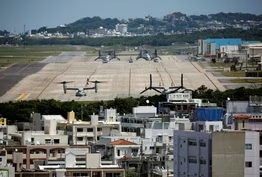
PATRICK FOK: Okinawans have been locked in a tug-of-war with the Japanese government over a plan to move the Futenma Air Base, where Ballard was stationed, to a base called Camp Schwab on the island's east coast.
Kinjo is among a group of islanders who fiercely oppose the relocation, demanding instead the U.S.
bases leave the island altogether.
They stage daily demonstrations outside Camp Schwab to try to stop its ongoing expansion.
TAKEMASA KINJO (through translator): They're pushing ahead with the work, and we're doing our utmost to delay it.
PATRICK FOK: Futenma Air Base has long been a symbol of local resentment towards the massive U.S.
footprint on Okinawa.
It's been called the most dangerous base in the world because of its close proximity to so many homes, schools, and businesses.
Not only does its location heighten the risk of accidents.
Residents have also had to endure the relentless noise of military aircraft flying directly over their neighborhoods.
But the boiling point came in 1995, when mass protests erupted after three U.S.
servicemen abducted and raped a 12-year-old Okinawan girl.
It resulted in the U.S.
agreeing to relocate its forces away from that base, but only once a fully operational replacement was completed.
So we have come onto this observation deck to get a better view of the Futenma Air Base.
That is the air base there in the distance.
Here, there is a sign detailing how Okinawa plans to use that land when it's given back to the island.
It includes green space, housing, businesses and community facilities, except, 30 years on, there's still no date for its closing, despite two more homicides linked to the U.S.
military in the past decade.
That's frustrating to locals like AI Oyafuso, another prominent anti-base activist here.
AI OYAFUSO, Anti-Base Advocate (through translator): My personal opinion is that none of these U.S.
bases belong here.
I see a huge problem with the way so much of our island is occupied and fenced up by the bases.
I can tell you from firsthand experience how these bases make our lives so difficult.
PATRICK FOK: She's the daughter of a U.S.
serviceman father and Okinawan mother, and believes the island has been negatively defined by its link to the military bases.
For generations, she told us, Okinawa has struggled to break free from that legacy, and it's been caught in the political crossfire between Tokyo and Washington.
AI OYAFUSO (through translator): People outside Okinawa may think we're simply opposed to having military bases here.
But, for us, the chain of problems caused by the bases is so deeply woven into our everyday life.
It's about the people living next door.
Our everyday lives have become political, and I think that's really important.
PATRICK FOK: But these bases are critical to U.S.
security in the Indo-Pacific, which is why Okinawa has become America's most important frontline military staging brand in Asia, even more right now as concerns grow over China's increasing military assertiveness and activity around nearby Taiwan, less than 500 miles away.
Okinawa's bases could provide a key staging point for U.S.
forces in the event of a Chinese attack on the island.
The U.S.
military's plans to keep its bases on Okinawa got a boost last month when voters elected a new governor.
Genta Koja campaigned on reviving the local economy and, in a sharp departure from his predecessors, supports the move of the U.S.
air base from Futenma to Camp Schwab on Henoko Bay.
Earlier today, he met with the senior us Marine commander on Okinawa, Benjamin Watson, who struck a conciliatory turn.
LT.
GEN.
BENJAMIN WATSON, U.S.
Marine Corps Forces, Japan, Commander: And I recognize that serious incidents cause significant concern and anxiety among the residents of Okinawa, who are our neighbors.
PATRICK FOK: The Okinawa governor conveyed the outrage of many on the island.
GOV.
GENTA KOJA, Okinawa Prefecture (through translator): Given that incidents of women being murdered took place in 2016 and 2019, the loss of an Okinawan life is deeply regrettable and fills me with immense anger.
PATRICK FOK: The new alleged murder brings the heavy burden of the U.S.
military presence back into sharp focus.
The bases may remain vital to America's strategy in Asia, but the scars they leave behind are proving harder to erase.
For the "PBS News Hour," I'm Patrick Fok reporting from Okinawa, Japan.
GEOFF BENNETT: Tonight, we're kicking off a new series all about GLP-1 medications.
Hailed by some as miracle drugs, GLP-1s have surged in popularity in the past few years.
An estimated one out of every eight Americans is now on some version of them.
And scientists continue to research new potential uses.
But with that rapid expansion, there's a growing list of questions and skeptics.
Our William Brangham starts our coverage of GLP-1s: Reshaping America.
WILLIAM BRANGHAM: The drugs are called glucagon-like peptide-1 receptor agonists.
Chances are, you have heard a lot about them, or at least some of their brand names.
NARRATOR: With Wegovy, you can live lighter.
NARRATOR: Who have taken Ozempic.
NARRATOR: Ask your doctor about Zepbound.
WILLIAM BRANGHAM: Today, these drugs are best known for their ability to help people manage their diabetes and to lose weight, sometimes at eye-popping rates.
SERENA WILLIAMS, Professional Tennis Player: GLP-1s helped me lose 31 pounds.
WILLIAM BRANGHAM: They have been promoted by celebrities.
WOMAN: GLP-1s to quiet the noise.
WOMAN: Wegovy now comes in a pill.
WILLIAM BRANGHAM: And now taken by millions of people across America.
MAN: The drugs really do what they say they're going to do, and they do it very well.
WOMAN: I started losing weight almost immediately.
MAN: So, so helpful.
The weight just melts off.
WILLIAM BRANGHAM: Researchers first discovered the GLP-1 hormone decades ago.
It helps regulate blood sugar by stimulating the body's release of insulin.
In the 1990s, scientists realized that the venomous lizard the Gila monster produced a molecule very similar to GLP-1.
That led to the development of the first GLP-1 drug to treat diabetes in humans.
It was approved by the FDA in 2005.
JULIA BELLUZ, Co-Author, "Food Intelligence": When we give people very high doses of synthetic GLP-1 in the form of these drugs, we get this array of astounding effects, from better managed blood sugar to weight loss, that we basically haven't seen outside of bariatric surgery.
WILLIAM BRANGHAM: The first GLP-1 specifically for weight loss was OKed in 2014.
For a while, researchers thought the weight loss benefits of GLP-1s started in a person's gut.
JULIA BELLUZ: But it turns out how they work for weight loss is quite different.
The drugs actually work through the brain to reduce appetite and reduce this thing that a lot of people refer to now as food noise or cravings or preoccupation with food that so many people feel.
And people eat less and end up losing weight as a result.
WILLIAM BRANGHAM: In some cases, patients can drop up to a quarter of their body weight.
And doctors are seeing other benefits too, like reduced inflammation and improved cardiovascular health.
But that's not all.
MAN: Could they be a magic bullet for cancer too?
WOMAN: Sleep apnea.
WOMAN: Addiction.
WOMAN: Liver disease.
What?
JULIA BELLUZ: We now have tens of millions of people on these drugs, and they're reporting back to the researchers all these other benefits that they're discovering, reversals of long COVID, arthritis, post-concussion syndrome, lupus symptoms controlled, irritable bowel syndrome that kind of plagued some of the people I have talked to for decades, and they go on a GLP-1 drug and suddenly their symptoms disappear.
WILLIAM BRANGHAM: But there are drawbacks, and we're not just talking about their high price, which we will get to in a minute.
According to one study, up to three-quarters of people who start taking these drugs stop within a year.
And when they do, they often quickly regain whatever weight they have lost.
And the side effects of these drugs can be hard to ignore, including nausea, vomiting, and diarrhea.
While patients drop fat, some lose critical muscle mass as well.
There are even rare reports of eye damage leading to blindness.
Thousands of patients have already filed lawsuits against the drugmakers, alleging they failed to adequately warn about these risks.
But just how widespread these effects are still remains to be seen.
JULIA BELLUZ: Science really needs to catch up.
And we will, I think, make discoveries of great benefits that we don't yet know about, but we're also going to discover disappointments and we will discover harms, especially as the numbers grow.
And I think it could very well be that billions of people take these drugs.
I think we're just at the beginning of the great GLP-1 experiment.
WILLIAM BRANGHAM: So back to this other major issue with GLP-1s, their price.
As more and more people get on the drugs, many employers and insurers have moved to drop insurance coverage.
And, without insurance, patients are sometimes forced to spend over $1,000 a month.
DR.
MEHMET OZ, Administrator, Centers for Medicare and Medicaid Services: Reducing the cost, for example, of what the president calls the fat shot, The Ozempic GLP-1 category of medications.
We dropped them dramatically.
WILLIAM BRANGHAM: The government has launched programs and struck deals with pharmaceutical companies to bring the cost as low as $50 a month for some people, but access is uneven.
MAN: I was literally having to make the decision between taking care of my family or getting the medication.
WOMAN: For the quality of life change that I have had by being on this drug, to me, it's really worth going through any financial challenges.
WILLIAM BRANGHAM: But there are some other key underlying questions here.
Will spending on GLP-1s today prevent all sorts of chronic diseases and thus reduce the cost of treating those diseases down the road?
And what kind of economic and societal impacts will come from a global GLP-1 industry that by one estimate could reach $200 billion by 2030?
JULIA BELLUZ: It's a drug that seems to work across so many conditions.
It's a drug that helps people lose weight in a way that humans have desired for so long.
It's also a drug that is very visual in our kind of social media age where you can post your before-and-after picture.
And it's a drug in our telemedicine moment where the barriers to entry for getting pharmaceuticals now is quite low.
And so I don't think we have ever seen anything like this in the history of medicine.
WILLIAM BRANGHAM: In the coming days, we're going to explore some of these big outstanding questions, the challenge of providing equal access to GLP-1s, how they can be used to treat addiction, and what happens when such potent weight loss drugs are deployed in our looks-obsessed culture.
For the "PBS News Hour," I'm William Brangham.
And this is GLP-1s: Reshaping America.
GEOFF BENNETT: And, tomorrow night, Stephanie Sy will explore which Americans have access to GLP-1s and who continues to be priced out.
President Trump is rallying Republicans in Nebraska tonight, while the White House has once again barred a media outlet from the press pool covering the president's travels.
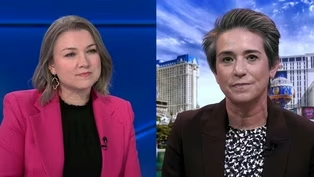
Our Politics Monday duo is here to break down that and more, Amy Walter of The Cook Political Report With Amy Walter and Tamara Keith of NPR.
So, Tam, in the closing stretch, the president is promising $5,000 dividends if Republicans hold Congress, $90 checks to Medicare enrollees, $500 rebates to some Obamacare customers.
We should say the president has made promises of payouts in the past that haven't materialized.
But is this an acknowledgement that Republicans still haven't found a stronger answer on this affordability question?
TAMARA KEITH, National Public Radio: You know, the fascinating thing is, I'm not hearing a lot of Republican candidates talking about these checks for everyone that President Trump is talking about.
They are more focused on the affordability issues that are much closer to home.
Republican candidates, Democratic candidates, everyone is hearing from people who are really upset about the price of gas, the price of groceries, the price of all the things.
And a lot of the candidates, Republican candidates, are at this point acknowledging, yes, things are too expensive.
You have had Republican candidates standing in grocery stores talking about things being too expensive.
They aren't really picking up the president's messaging on this.
They are more in the mode of acknowledging pain.
GEOFF BENNETT: Over to you, Amy, in Nevada tonight.
The president is planning campaign stops in 10 states this month, not just traditional battlegrounds, but in some surprisingly competitive red states.
What can you take away from his travel schedule in terms of where Republicans are most concerned?
AMY WALTER, The Cook Political Report: Yes, his travel schedule matches the spending that Republican candidates and the especially the Republican committees, campaign committees, and their super PACs are spending.
Just this last week, we have seen that the Republicans' main super PAC has basically triaged two states that, earlier this year, earlier this cycle, Geoff, I would have said would have been just close right to the very end, Georgia and North Carolina.
They're taking money out of those purple states and putting them into dark red states like Kansas and continuing to spend very heavily to save a seat in Texas.
We're also hearing, when I talk to my House sources, they're also seeing Republicans now having to spend money in states that the president was carrying by 10 points or more.
So what we have seen really since the end of the summer is a real deterioration in the political environment.
And what that means now is, Democrats are competing in the kinds of districts and states that not so long ago looked basically impenetrable for Democrats.
Now, look, Democrats aren't going to win all of those, but if you're Republicans right now, your main priority is to try to defend as many of those Trump seats as you can.
And they're still playing offense, Republicans still playing offense, particularly in one blue state, and that's Michigan.
But other than that, most of their spending is defense.
GEOFF BENNETT: And, Tam, as the president hits the road, a question about presidential press coverage.
A federal judge restored the White House access of CNN, Politico, and MS NOW after the president banned them.
But the White House is still keeping CNN and Politico off of Air Force One.
And the major news organizations have responded with a blackout when one of the affected outlets would otherwise be in the pool, but they haven't issued a blanket blackout of Trump coverage.
Why take that limited approach?
And does it let the White House off the hook?
TAMARA KEITH: Yes, I mean, I think that there is a really challenging balance that all serious independent news organizations are facing right now, which is, do you provide coverage of the president, which serves the public, which puts scrutiny on the president, as all presidents should have scrutiny, or do you boycott or step back?
I think that ultimately news organizations are not filling the slots of Politico and CNN, but they aren't doing a blanket boycott because they do feel that obligation to provide coverage.
Now, that does in a way allow the White House to continue doing this, to continue punishing news organizations.
But it tipped -- the scales are tipped in favor of the public's right to know and the ability of organizations who are there on the plane or in the Oval Office to ask difficult questions, to ask the important news-of-the-day questions.
But it's really tough.
And it is -- the White House is leaning on a not final judicial ruling that said that there's a distinction between the White House grounds and then these more private spaces like Air Force One or the Oval Office.
It's not clear ultimately that the law will be on their side when this is all done being appealed, but legal processes take a really long time, and the White House is exerting its power in the meantime.
GEOFF BENNETT: And, Amy, as we inch closer toward the midterms, the polls underestimated President Trump in three presidential elections.
They were more accurate in the midterms.
As we head into the midterms and poll after poll shows Democrats with a better-than-average shot of taking potentially both houses, how do we know those polls are accurate?
AMY WALTER: Right.
Well, the short answer is, you should take every single poll and understand that they do have a margin of error.
So the accuracy is just within a certain band.
But I do think that, for Republicans, their one hope here is that it's not that the polls are rigged or that there's something wrong with the polls, but that it is simply difficult to capture the kinds of voters right now that Republicans really need to turn out in order to be able to hold their own in this midterm election.
And that is disappointed, disaffected Republican voters.
Those people are less likely to answer questions from pollsters.
They're probably difficult to reach.
But what Republicans have to hope is that, even though they're not getting picked up in the polls, because, quite frankly, they're not feeling great about things right now, they do ultimately show up to vote.
The other thing that we know is that the campaigns themselves, the Republican campaigns, they're spending millions of dollars on TV ads, but they're also spending millions of dollars to target and turn out those same voters.
So, if we wake up on Election Day and -- the day after the election, I'm sorry, and we find out that Republicans, they ended up holding the Senate and not losing as many seats as predicted in the House, it will be because, remember, as I said earlier, all of the fighting is happening on Republican turf.
And so those Republicans, even though they aren't feeling great about the economy, they're not feeling great necessarily about the way that the president's handling his job, they do feel -- they did feel an obligation to show up and vote, mostly because they didn't want Democrats to get in charge, not because they were sending a vote of approval necessarily to Republicans.
GEOFF BENNETT: Amy Walter and Tamara Keith, thanks, as always.
TAMARA KEITH: You're welcome.
GEOFF BENNETT: When Robert Prevost stepped onto the balcony of St.
Peter's Basilica last year as Pope Leo XIV, he made history as the first American to lead the Catholic Church.
But the path that brought him there stretched from Chicago's South Side to decades of missionary work in Peru, and ultimately to the highest ranks of the Vatican.
The new book "American Pope" traces that unlikely journey and offers a fuller portrait of the man behind the papacy.
Its authors are Scott Detrow, host of NPR's "All Things Considered," and Daniel Burke, NPR senior editor of religion and spirituality.
I recently spoke with them.
Scott Detrow, Daniel Burke, welcome to the "News Hour."
SCOTT DETROW: Thanks for having us.
DANIEL BURKE: Great to be here.
GEOFF BENNETT: And, Scott, you were in Rome during the conclave when Robert Prevost's name first came up, and you had actually circled his name in your notebook at the time.
What did you know about him then and what did you realize you didn't know about him when he became the pope?
SCOTT DETROW: Not that much at first, and I think I wasn't alone.
Several people in Rome were saying, like, you got to think about Robert Prevost, and then you would say, the American?
That's a nonstarter.
And everyone said, yes, yes, yes, but he -- for somebody from the United States, there was this assumption that the church wouldn't want to give that much power to an American, especially going back -- this is the first few months of the Trump administration, where President Trump is putting all these policies in place that are kind of shaking up the world order.
And that seemed to just double down on this given in Catholic Church history that the United States for the last couple hundred years is the most powerful country in the world.
You wouldn't want to make a pope an American.
But the fact was, this guy who grows up in Chicago, this Midwesterner, becomes over the last two years one of Pope Francis' allies.
They're meeting for hours at a time on Saturday mornings.
In retrospect, Pope Francis was kind of taking Robert Prevost to pope school.
And he subtly -- because I think if he had done it too bluntly, it would have backfired.
He's kind of subtly pointing to his allies who he knows are going to choose the next pope and saying, this is the guy that I'm entrusting.
This is the guy who you should really consider.
And despite the fact that he is an American, he goes into the conclave and all of the other cardinals start talking to each other and they realize, this is the path forward for our church.
GEOFF BENNETT: And Prevost, Pope Leo, grew up, obviously, in Chicago, attended Villanova, in many ways purely American story, but so much of his adult life was informed by living in Peru.
DANIEL BURKE: That's right.
He goes to Peru in his early 30s.
It was kind of a surprise to him.
He had thought about missionary life a little bit as a teenager in high school, but he was on the path to elevate him in Rome.
He was studying in one of the most prestigious universities.
He was studying canon law.
But there was a car accident, and they needed a canon lawyer very quickly.
And so his order, the Order of Saint Augustine, sent him down there.
He didn't quite take to it first.
He gets to Chulucanas, which is in northwest Peru, where El Nino had just swept through.
houses were dissolved in mud.
Farm fields were lying in water.
And so he really gets there and he says, lord, where have you taken me?
And it just looks like complete devastation.
He winds up not only loving Peru, but going back twice.
So it was a really, really important part of his ministry.
It's -- he says it's where he learned to be a priest.
GEOFF BENNETT: Yes.
You mentioned Pope Francis.
And he, of course, was a much more public disruptive figure.
And there's a cardinal who gives you this great comparison.
He says: "Francis was a bulldozer clearing the road.
Leo is a leveler, quietly smoothing it."
What does that tell us about the difference between those two men and where Leo might ultimately take the church?
SCOTT DETROW: That was that was Cardinal Pedro Barreto who told us that.
He's a Peruvian cardinal, and he told us that.
That interview was toward the end of our reporting process, and he said that, and it just crystallized to us.
Like, yes, that is the difference in their style.
This is the perfect way to think about these two men.
Because Francis and Leo have a lot of the same goals.
They both care deeply about the issue of immigrants and what's going on right now with global politics and the way that leaders talk about immigrants.
That's a deep concern to both of them.
They both want to create a church that is a lot more open-minded and group consensus is an important part of the process.
They don't like the idea of the pope dictating from on high, which is the way it's run for a couple thousand years.
But they go about it much more differently.
And I think that's also a reason why Leo was elected, because he's a lot more of a methodical leader.
He's a lot more of a calculating person.
He is thinking eight to 10 to 20 steps ahead.
He is thinking years down the line.
And a lot of conservative cardinals who were in the conclave who kind of wanted a stylistic break from Francis, they looked at Robert Prevost, and even though he was a close ally of Francis, they realized he would run the church a lot differently, and that's something that we can get behind as well.
GEOFF BENNETT: And there has been this effort to fit the pope into familiar political categories.
Is he a moderate?
Is he a progressive?
Based on your reporting, how useful are those labels, if at all, in understanding who he really is?
DANIEL BURKE: Yes, not very.
We talked to a number of priests in Peru who knew him really well.
He was very careful about getting involved in Peruvian politics, which can be even more chaotic than American politics, if you can believe that.
But this priest told us that everyone wants to know, is Roberto Prevost, is he a liberal or is he conservative?
And he says he's neither.
He follows the signs of the time.
He follows Jesus.
And so we kept seeing this time and time again where he would address issues, like making sure that people had infrastructure, running water, roofs over their heads.
But he would not align with any particular political party.
He was very, very careful.
He wouldn't attend that many political marches or rallies and things like that.
We see that now.
He will talk about an issue, the Iran war or artificial intelligence.
He won't go after particular people, which is another difference from Francis.
Francis was very pointed in his critiques, if you remember.
Robert Prevost, Pope Leo XIV, is much more I would say, kind of peaceful, serene about the way he attacks these kind of global issues.
He doesn't go after people personally in that way.
GEOFF BENNETT: The book frames the clergy's sexual abuse crisis as one of the defining upheavals that he faced through on his path to becoming pope.
What did you find out about how he handled allegations that fell to him during that period?
DANIEL BURKE: Yes.
So, in 2001 and 2002, he is the leader of the Augustinian Order, and so cases of priests who were accused of abuse came to his desk.
To that point, he hadn't had a lot of experience dealing with abuse cases.
He had been in Peru and in Rome, where it wasn't seen as big an issue as it truly was.
And so priests told me he was a little slow on the uptake, to be honest.
There were priests that needed to be removed from office rather immediately, and he took his time to think about it.
That's also kind of characteristic of his leadership.
But once he understood the issue, he came back, the priest was defrocked, and he really kind of understood what he needed to do.
GEOFF BENNETT: You have interviewed more than 100 people.
You have dug through archives.
You have read through letters and e-mails that hadn't been seen publicly.
Was there something that really changed your understanding of Pope Leo and who he is and where he came from?
SCOTT DETROW: Daniel was the one who dug it up, and we were talking about it.
There's this moment that it doesn't really seem like a big deal in terms of the issues on his plate now, but he was -- he had just taken charge of the Midwest Augustinians.
He's back in Chicago for the first time in decades.
And he had spent the last decade in Peru dealing with life-or-death issues, and he's dealing with this challenge where one of the priests in the community has broken one of their vows by purchasing a house.
And all the other friars are really mad about this, understandably.
And we found the letters that he was sending, and the way that he's sorting through all these complicated things and personal dynamics.
And he sends this letter saying, look, here's how I'm going to deal with this.
A lot of you aren't going to be happy, but here's why I'm making the solution.
He's going to keep the house, but the deed is going to come back to our order, and, again, just like day-to-day stuff, but I think, like, you see in really large-scale issues and small-bore issues, the way that he approaches things, his leadership style is that he listens.
He is a big listener.
He is often the last person to talk in a meeting if he talks at all.
And he really, deeply wants to know what everybody's take is, what everybody's view is, and he takes it into consideration.
A lot of the times, the answer, just like in that case, the answer that he gives is not what everybody wants to hear, but he keeps people on board with his vision and his approach because of the way that he's intently listening at all times.
And we're seeing that now on a global stage with him as pope.
And I think it's a leadership style a lot of people get behind.
GEOFF BENNETT: Scott Detrow and Daniel Burke, the book "American Pope: Leo XIV's Road from the South Side of Chicago to Vatican City."
Great to speak with you both.
DANIEL BURKE: Thank you.
SCOTT DETROW: Thanks so much.
GEOFF BENNETT: A free press is protected by the Constitution.
But what happens when those protections are put under pressure, and news organizations themselves have to decide how hard to push back?
That question is among the many explored in a new PBS documentary "The First" co-hosted by journalists Tom Costello and Bazi Kanani.
Here's a preview with former New York Times executive editor Dean Baquet on the challenge facing the press as many faced government lawsuits.
DEAN BAQUET, Former Executive Editor, The New York Times: A lawsuit deadens your journalism.
A lawsuit makes you afraid.
A lawsuit eats up your time.
A lawsuit eats up your energy.
And a lawsuit can even put you out of business.
TOM COSTELLO, Co-Host: And that is exactly the point.
DEAN BAQUET: That's exactly the point.
TOM COSTELLO: And that is a threat to the First Amendment.
DEAN BAQUET: That's exactly right.
If you are sitting there -- if a journalist sits at the typewriter afraid of the lawsuit, that's a very different emotion than sitting at the typewriter and making sure you got it right.
GEOFF BENNETT: You can watch "The First" on the PBS app and on your local PBS station.
Check your local listings.
And that's the "News Hour" for tonight.
I'm Geoff Bennett.
Thank you for spending part of your evening with us.

'American Pope' traces Leo's journey from Chicago to Vatican
Video has Closed Captions
'American Pope' traces Leo's journey from Chicago to the Vatican (8m 45s)

As GLP-1s reshape America, questions and new uses emerge
Video has Closed Captions
As GLP-1s reshape America, questions and new uses emerge (6m 54s)
Marine's arrest in Japan fuels debate over U.S. presence
Video has Closed Captions
Marine's murder charge in Japan fuels local debate over U.S. military presence (7m 8s)
News Wrap: Cornell students protest handling of alleged rape
Video has Closed Captions
News Wrap: Cornell students protest handling of alleged rape (5m 59s)
Supreme Court weighs climate liability for energy companies
Video has Closed Captions
Supreme Court hears case on holding energy companies liable for climate change (7m 42s)
Tamara Keith and Amy Walter on Trump's payout promises
Video has Closed Captions
Tamara Keith and Amy Walter on Trump's payout promises (7m 54s)
What to know about pneumonic plague after Russian lab death
Video has Closed Captions
Understanding pneumonic plague after Russian lab worker's death (6m 47s)
Providing Support for PBS.org
Learn Moreabout PBS online sponsorship New Episode
- News and Public Affairs

FRONTLINE is investigative journalism that questions, explains and changes our world.
 New Episode
- News and Public Affairs

Today's top journalists discuss Washington's current political events and public affairs.
 From My Station
 New Episode
 New Episode
 New Episode
 New Episode
 New Episode
 New Episode
 New Episode
Support for PBS provided by:
Major corporate funding for the PBS News Hour is provided by BDO, BNSF, Consumer Cellular, American Cruise Lines, and Raymond James. Funding for the PBS NewsHour Weekend is provided by...