
Skiing Greenland for Science
Clip: Episode 1 | 4m 48sVideo has Closed Captions
Five strangers, 220-pound sleds, 30 days on Greenland's ice, all to map what lies beneath.
Most parties who cross the Greenland ice sheet come for adventure. Dr. Adrian McCallum's team of five, strangers from five countries, comes for data. Hauling 220-pound sleds for a month and pitching camp every night, they drag ground-penetrating radar across nearly 370 miles and measure winter snow, tracking how quickly it compacts into ice and what that could mean for sea level rise.
Problems playing video? | Closed Captioning Feedback
Problems playing video? | Closed Captioning Feedback
Skiing Greenland for Science
Clip: Episode 1 | 4m 48sVideo has Closed Captions
Most parties who cross the Greenland ice sheet come for adventure. Dr. Adrian McCallum's team of five, strangers from five countries, comes for data. Hauling 220-pound sleds for a month and pitching camp every night, they drag ground-penetrating radar across nearly 370 miles and measure winter snow, tracking how quickly it compacts into ice and what that could mean for sea level rise.
Problems playing video? | Closed Captioning Feedback
Where to Watch Ages of Ice
Ages of Ice is available to stream on pbs.org and the PBS app.
Share Inspiring Moments From The Film
Explore the PBS Giphy collection for Ages of Ice.Providing Support for PBS.org
Learn Moreabout PBS online sponsorship♪ Narrator: Somewhere that also feels like nowhere on the Greenland ice sheet.
A team of adventurers and scientists set out on a data collecting journey of almost 370 miles.
The Greenland ice sheet is traversed occasionally by perhaps ten to a dozen parties every year.
All of those typically are adventurous parties.
Very rarely, very, very rarely do we get scientific traverse expeditions that actually will travel across the Greenland ice sheet, gathering data as they go.
My name is Adrian McCallum.
I'm a scientist and engineer from the University of the Sunshine Coast in Australia.
The icy parts of the planet where I like to work to some extent, can give us the pulse of the planet.
What is happening?
How is it faring?
He's covering ice.
And then, of course, we can project what implications that might have to sea level rise.
Yeah, that's it, that's it.
Okay, team.
Narrator: For the next 30 days, Adrian and the team will attempt to cross the entire Greenland ice sheet.
Each pulling a 220 pound sled across one of the most hostile environments on Earth.
Out here, exhaustion, storms, and extreme cold can end an expedition fast.
But their goal is to map the hidden world below with radar and measure how much snow the ice sheet has gained over winter.
We are collecting ground penetrating radar data, where I'm dragging a radar behind my sled which projects energy into the ice sheet, which bounces off reflections within the ice sheet, comes back to the surface.
We can then work out how deep particular snow ice interfaces are.
Everything is working.
Yeah, yeah we got data, yes.
25 Meg of radar data at -30.
Oh nice.
Hasnt been collected here before, so, so far, so good.
The routine is relentless.
Ski 12 miles, then build a home on the ice every single day.
Were five people from five different countries.
We never met until we met in Kangalussuaq Greenland 12 days ago.
Life in Greenland, ha.
It's not too bad.
We've got Niklas from Germany.
Laura from Greenland, she's Danish.
Jan, our expedition coordinator from Copenhagen.
And we've got Jens, our surgeon from Sweden.
Whats dinner tonight?
Turkish falafel.
Haven't tried it before.
Narrator: For the next month, home will be under canvas with all five squeezed in together.
[Snoring] [Speaking German] [Speaking German] Probably the coldest morning so far?
Oh, its only minus 14 in the tent now.
Noticeably harder Narrator: Each day Adrian measures the depth and density of the snow.
Ten, so there, above the ice.
Narrator: Revealing how much water is stored here and how quickly it's compacting into ice.
170.
Narrator: However, the team needs to keep moving.
It says it's receiving radar data, it says the internal GPS is okay.
That's all okay.
GPS: No GPS Present.
So it looks like we are good to go.
As you can hear there's no external GPS.
We're using the GPS on the phone which is fine.
So we'll take the radar for a bit of a drag and see what we can find.
GPS: No GPS present.
No GPS present.
Video has Closed Captions
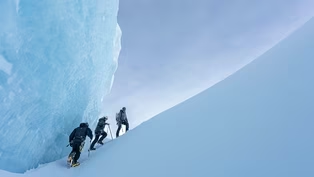
Clip: Ep1 | 4m 58s | Is Greenland's ice leaking methane? Glaciologist Alun Hubbard descends into a moulin to find out. (4m 58s)
Providing Support for PBS.org
Learn Moreabout PBS online sponsorship New Episode
- Science and Nature

Explore scientific discoveries on television's most acclaimed science documentary series.
- Science and Nature

Miles O'Brien travels the world searching for solutions to today’s most urgent challenges.












Support for PBS provided by: