
April 22, 2023 - PBS News Weekend full episode
4/22/2023 | 26m 38sVideo has Closed Captions
April 22, 2023 - PBS News Weekend full episode
April 22, 2023 - PBS News Weekend full episode
Problems playing video? | Closed Captioning Feedback
Problems playing video? | Closed Captioning Feedback
Major corporate funding for the PBS News Hour is provided by BDO, BNSF, Consumer Cellular, American Cruise Lines, and Raymond James. Funding for the PBS NewsHour Weekend is provided by...
April 22, 2023 - PBS News Weekend full episode
4/22/2023 | 26m 38sVideo has Closed Captions
April 22, 2023 - PBS News Weekend full episode
Problems playing video? | Closed Captioning Feedback
How to Watch PBS News Hour
PBS News Hour is available to stream on pbs.org and the free PBS App, available on iPhone, Apple TV, Android TV, Android smartphones, Amazon Fire TV, Amazon Fire Tablet, Roku, Samsung Smart TV, and Vizio.
Providing Support for PBS.org
Learn Moreabout PBS online sponsorship(BREAK) JOHN YANG: Tonight on "PBS News Weekend," as the Supreme Court preserves access to the drug used in most U.S. abortions, we look at the online misinformation and disinformation about abortion.
Then, glitches plague a cell phone app that helps migrants apply for asylum as pandemic era immigration policies are set to end.
And what scientists are doing to rescue disappearing plant life across the globe?
SUSAN PELL: Plants are, you know, the keystone species and pretty much every habitat and by saving the plants, saving the habitats that they're in, we're also saving all the other biodiversity.
(BREAK) JOHN YANG: Good evening, I'm John Yang.
With the bloody battle for control of the North African nation of Sudan entering its second week, the Sudanese army says it's helping evacuate foreign diplomats and civilians aboard military aircraft.
But the American Embassy there says it's too dangerous for the estimated 16,000 private U.S. citizens trapped in Sudan to travel and urge them to shelter indoors.
Explosions and gunfire rang out across the capital Khartoum today, even as the warring sides said they'd agreed to a ceasefire for the three-day Muslim holiday marking the end of Ramadan.
The World Health Organization says that more than 400 people have died, including one American.
Interior Secretary Deb Haaland defended the Biden administration's approval of the will oil drilling project in Alaska.
Speaking before a group of environmental journalists in Idaho Haaland rejected criticisms that President Biden broke a campaign pledge to end new drilling on federal lands.
DEB HAALAND, U.S. Secretary of the Interior: We are not going to turn the faucet off and say we're not drilling anymore.
Nobody's going to use gas and oil.
That's -- that is not reality.
So we are doing the best we absolutely can.
JOHN YANG: The $8 billion Willow project is projected to bring in 180,000 barrels of oil a day.
Haaland opposed Willow when she was in Congress before she joined the administration.
And Australian Actor Barry Humphries has died.
He was better known to his fans worldwide as his alter ego, the outrageous Dame Edna, a sharp tongue quick witted diva who punctured pomposity and the culture of celebrity.
More than a character Dame Edna became a cultural phenomenon.
In 1999 Broadway show won a special Tony Award.
Barry Humphries was 89 years old.
Still to come on "PBS News Weekend," will a Customs and Border Protection app help or further complicate applications for asylum at the southern border?
And scientists race to save disappearing plant life?
(BREAK) JOHN YANG: Supreme Court said last night that the abortion medication mifepristone will remain available while the challenge to a lower court order that it'd be taken off the market works its way through the legal system.
This later -- latest chapter in the legal fight over abortion access comes as researchers are examining the vast amount of online misinformation and disinformation about abortion.
Jenna Sherman is with me, Meedan Digital Health Lab, a technology nonprofit that works just strengthen journalism and digital literacy.
She's also a researcher at Harvard's TH Chan School of Public Health.
Jenna, I know that at Meedan you recently looked at what happened with online misinformation and disinformation around last year's leak of both the leak of the draft Supreme Court opinion.
And then when the actual opinion came out, overturning Roe, what did you find?
JENNA SHERMAN, Meedan Digital Health Lab: Yes.
Thanks so much, John.
Yeah, so we wanted to understand how actual volume of mis and disinformation changed about abortion online.
So we went through hundreds of tweets from before the leak and the decision and then after the leak and decision.
And what we found is that the percentage of tweets containing misinformation stayed the same.
And you might be thinking, well, if it stayed the same, that's not very significant.
But what's important to keep in mind here is that the noise around abortion online was extraordinarily high.
So the percentage saying the same actually indicated that the volume of misinformation skyrocketed, following both the leak and the decision and then quickly fell within a few days already making an impact and already causing harm most likely.
JOHN YANG: Did you see the same thing?
You know, mifepristone has been in the headlines for the last two weeks since that ruling in Texas?
Have you seen the same thing?
JENNA SHERMAN: Absolutely, John.
We have been seeing the same thing.
We predicted that mis and disinformation around medication abortion would increase after originally the leak and then the decision because it really has become the new battlefront for anti-abortion activists in their fight against abortion to end all forms of abortion.
And we have seen their tactics become really successful online as we've seen claims circulating that exaggerate the harms of medication abortion, that use very shoddy and in many cases, non-rigorous science, and the do a lot of fear mongering and stigmatizing around people who are considering using medication abortion in a manner that is unjustified based on the scientific literature.
And what's really concerning to me, John, is that we are seeing many of those same claims in the actual legal appeals themselves, the ruling that the Texas judge put forth that I looked at, had at least 20 unique, false or misleading claims that were mis aligned with scientific consensus.
And that's just an example of the cycle that we're in where mis and disinformation online, gets baked into our legal and policy decisions, and then bolsters the missing disinformation online and the cycle continues.
JOHN YANG: What you're talking about seems to have been coming from the anti-abortion forces.
Is there anything coming?
Do you see any misinformation or disinformation coming from abortion rights supporters?
JENNA SHERMAN: It's a great question.
So well, we have found observationally that most disinformation which is intentionally spread, false and misleading content comes from more conservative leaning anti-abortion groups and individuals.
Misinformation is really spread across the ideological spectrum.
So some examples of claims that have been put across on social media by folks who are really on the side for abortion rights have been, for instance, claims around being able to use herbs or natural remedies to safely induce abortion, which is not scientifically evidenced, and also downplaying really legitimate risks of abortion.
And this just goes to show how politicized and subjectively perceived this abortion debate is and how it really confounds the public debate.
JOHN YANG: How, what can people do about this?
And does the burden fall on the social media platforms?
Or does it fall on the user's social media users to be careful about what they read?
JENNA SHERMAN: Absolutely, we're of the opinion that the onus should really first and foremost be on the tech companies and the social media platforms.
There is a role for individual users to play but what platforms should really be focusing on is using a both reactive approach and proactive approach and parallel, a lot of the arguments around, you know, monitoring and moderating abortion content or any content online is that it's limiting free speech.
Well, in that argument, we're mostly talking about takedowns and shadow bans, and that is one really small tool in a really large toolbox.
But we really need to be focusing on is a parallel approach where we do some takedowns and at the same time, are proactively giving people medically sound context for the type of information that they're consuming, you know, we should really be empowering users to be, you know, be more ethical, conscious and informed consumers of content online.
And especially now given what we found in this report to pay extra attention to potential misleading content in the wake of really large public debates, news events and legal decisions.
JOHN YANG: How do you combat the fact that I think people are prone to accept and believe arguments that bolster what they already believe?
JENNA SHERMAN: It's a challenge.
And I think that the tricky part of it is that the online space is not a very -- it's not a space that's very adept to being critical and consuming content in a nuanced way.
I think, you know, what people need to do, including myself, including all of us is approach, especially medical claims with a really objective viewpoint, no matter what your belief is, whether you're for abortion or against abortion, we all have, you know, the responsibility to be conscious consumers when it comes to health information.
JOHN YANG: Jenna Sherman of the Meedan Digital Health Lab at Harvard's T.H.
Chan School of Public Health, thank you very much.
JENNA SHERMAN: Thank you, John.
JOHN YANG: The Biden administration is using a cell phone app as the main quarter for migrants seeking asylum at the U.S. Mexico border.
The app was first rolled out in January, but it's been plagued with glitches.
As Ali Rogen tells us, that's forcing tens of thousands of people to compete daily for a limited number of appointments.
ALI ROGIN: Since March 2020, a public health policy called Title 42 has allowed border agents to expel migrants, even those who are seeking asylum.
But that policy ends on May 11.
And the Customs and Border Patrol app could become even more essential.
Here to discuss this Wall Street Journal Immigration Reporter Michelle Hackman.
Michelle, thank you so much for joining us.
Let's remind everybody first, how does Title 42 work?
And how does this app fit in with the Title 42 process?
MICHELLE HACKMAN, Wall Street Journal Immigration Reporter: So Title 42 is a policy that because of public health reasons, allows the government to sort of they call it expelling migrants back to Mexico or their home country is on the risk that they might spread COVID.
But the really key point here is that it prevents the migrants, the asylum seekers from even asking for asylum under normal circumstances, if you ask for asylum, they cannot kick you out of the country.
I mean, that's how asylum law works.
ALI ROGIN: And then this new system that is replacing Title 42, how does it work?
And then how does this app fit into that?
MICHELLE HACKMAN: Yeah, so this app, it's called CBP One, it's actually been introduced already, even while Title 42 is still in place.
And the way it works is that if you're an asylum seeker, you essentially can't ask for asylum if you cross the border illegally, which is the way that most people try.
And so instead, the government is saying use this app, book an appointment, you can come to a legal port of entry and ask for asylum.
And we'll take you.
The only issue is there are just way fewer appointments than there are people who want them.
ALI ROGIN: And let's talk about what problem exactly this app is trying to fix?
MICHELLE HACKMAN: The Biden administration, you know, is taking, I would say a slightly different approach from the Trump administration where a like the Trump administration, they're saying, we really don't want you to cross illegally, you know, it's unsafe for everyone involved, it creates chaos.
It doesn't allow us to screen who's entering our country.
But unlike Trump, they're saying to try to convince people to not come illegally, you have to give them another option.
So this is that other option at ports of entry.
ALI ROGIN: And there are a couple other things that the Biden administration is trying, they've opened up some additional legal pathways.
Can you talk about those?
MICHELLE HACKMAN: So they're trying this totally new idea that that is sort of a novel legal theory where they're saying, you know, even if you don't qualify for a visa, and you're from a certain set of countries, where you're fleeing from authoritarianism, say, you know, Venezuela or Cuba, you can apply to come to the U.S. as long as you have a sponsor who will take you will let you fly here legally to the city of your choice.
Let's say you want to go to Chicago.
And we'll give you a legal permit to be here for two years at work.
So it's sort of an incentive, because it's a way better situation than crossing the border and immediately being put in immigration court.
ALI ROGIN: You were recently at the border where people are using this app to apply for these appointments.
How is it working?
What are some of the problems that folks are facing?
And also, what is life like for people on that side of the border?
MICHELLE HACKMAN: It's interesting, we haven't actually tried using a mobile app to do border management before.
And like any other app that you download on your phone, it's not perfect, you know.
People every day in the morning, they log on to try to get an appointment.
There are new appointments made available every day, let's say at about 9 a.m.
But there's so many people trying at the same time that the app stalls, you know, it goes gray or it gives you a 504 error.
Sometimes, you know, this is a big issue that the government's been trying to solve.
There are a lot of migrants, let's say from Haiti, who have darker facial complexions and you have to take a picture to prove it to you before you get your appointment and it struggles.
I mean with those darker complexions it sometimes doesn't recognize people's faces.
And what it's doing is it's sort of creating this tense sort of atmosphere where people don't know if they're going to get an appointment when they're going to get an appointment, how long they're going to be in Mexico, you know, Mexico can be really dangerous.
And so it's leading people to sort of stay put, and I think get increasingly desperate.
ALI ROGIN: There seems to be bipartisan opposition to this app.
And these policies, liberals are saying that this makes immigration too much like a ticket master.
And conservatives say that these efforts are expanding legal immigration too much.
So what constituency is the Biden administration trying to please with these efforts?
MICHELLE HACKMAN: I don't think that they're trying to please anyone.
They want to bring down illegal border crossings.
And their theory is that you can't do that through deterrence alone, because that is sort of ignoring the level of desperation among migrants in the region.
And desperation, always we have seen in the past sort of overcomes however much deterrence you're trying to put in someone's way.
And so they're trying to see if we are successful with this model where people come legally, and you don't have those images on TV have like thousands of people streaming across the border, that they might actually change some of the politics around immigration.
ALI ROGIN: Lastly, Michelle, Title 42 is ending.
But it seems with this new policy, that we're certainly not going back to the way asylum was treated before the pandemic.
So does this indicate that there is just a fundamental shift happening in how the United States views asylum?
MICHELLE HACKMAN: Yeah, I think so.
I think forever Republicans in particular, their frustration has been that the asylum system works in such a way where if you walk across the border, even if you're a foot across the border, you're in U.S. territory, and you can ask for asylum, and so many people do that.
That amount takes years for us to get through those cases.
And in the meantime, people become settled into American society.
And I think what Title 42 taught us is that people kind of like this idea that you can deny people the chance to do that.
And I think even some Democrats feel like, you know, we should have the ability to screen who's coming into our country, and sort of choose how many people were able to help that we can't help infinite numbers of people.
ALI ROGIN: Immigration reporter Michelle Hackman with the Wall Street Journal, thank you so much for joining us.
MICHELLE HACKMAN: Thank you.
JOHN YANG: Sorry to say that 80% of the Earth's species are not yet known, and even as more are identified, more are disappearing.
Sometimes we don't know what's being lost until it's too late.
On this Earth Day, we begin our series looking at what it takes to save plants and animals.
We call it "Saving Species."
And our first installment looks at the world of plants.
KENNY SILVEIRA, Plant Specialist, U.S. Botanic Garden: I am pulling off the fruits of this cactus.
JOHN YANG: Seed by tiny seed, meticulous and for some mundane work.
KENNY SILVEIRA: The little black dots that are coming out are the seeds of this cactus.
JOHN YANG: This is how you save a species.
Kenny Silveira is one of the dozens of horticulturalists at the U.S. Botanic Garden in Washington D.C., who are working to give some of the world's most endangered and rare plant species a better chance of survival.
The Botanic Garden which is part of Congress is a living plant museum with 44,000 fascinating plants with intriguing stories spread across a conservatory and a production facility.
These are from all over the world?
SUSAN PELL, Executive Director, U.S. Botanic Garden: They are so â| JOHN YANG: Executive Director Susan Pell let us through the mist, heat, and humidity stopping to talk under a giant leaf of the endangered corpse flower.
SUSAN PELL: I can tell you that about 34% of all of the plants in the United States are at risk of becoming endangered.
We see similar numbers globally with that where there's about 40% of global flora is at risk of extinction.
JOHN YANG: Scientists say the planet is currently at the beginning of its sixth mass extinction, when a high percentage of biodiversity, animals, plants, trees die off.
What's driving this, is it climate change?
SUSAN PELL: Certainly climate change is a huge factor and the risks that we see to our world's flora.
But there's other factors as well.
Certainly the developments from, you know, wild lands into agricultural use or buildings.
Another factor in there is the introduction of invasive species.
So the transportation of species around the globe and introducing them into areas in which they didn't evolve, really, most of the driver of extinction is human activity.
JOHN YANG: Experts estimate the world was losing species of all kinds and a rate between 1000 and 10,000 times higher than the natural extinction rate.
For conservationists, it's a race against time to do whatever they can to save species and their ecosystems.
SUSAN PELL: Plants are, you know, the keystone species and pretty much every habitat and by saving the plants saving the habitats that they're on we're also saving all the other biodiversity.
And, of course, biodiversity has a lot of benefits to, you know, our global climate, certainly to us as individual people.
JOHN YANG: In Australia, lawmakers set aside 30% of the entire continent to protect endangered plants and animal species and their habitats.
In South Africa, scientists are working to get rid of an invasive species that's clogging waterways, the water hyacinth.
In Albania, protesters are trying to stop development projects and an important migratory bird sanctuary and add a United Nations Conference in December 188 nations reached a landmark agreement to halt and reverse the destruction of nature by the end of the decade.
SUSAN PELL: We're entering our Hawaii room and the conservatory.
JOHN YANG: An ambitious goal institutions like the U.S. Botanic Garden are trying to help achieve.
SUSAN PELL: A cabbage on a stick or Brighamia insignis.
And this plant is extinct in the wild in Hawaii.
Originally, the seeds were collected from these plants from a cliff face and Hawaii so botanists had to actually repel down and collect the seeds from the plant.
And there are many stories about imperiled plants where they were down to one population or a few individuals and botanist or horticulturist went out and collected seeds from the plants or cuttings from the plants to bring them into cultivation to save them.
JOHN YANG: Part of saving these plants is understanding them better.
Pell showed us one plant a member of the a -_-_ 00:01:40 white family, she had never seen bloom before.
SUSAN PELL: If you look down in here, you'll see a little polka dots.
If you look a little deeper, there's some bigger polka dots.
Each of those little dots is a single individual flower.
JOHN YANG: And you said you'd never seen these sort of â| SUSAN PELL: I have not seen this species in bloom.
You know, we've been propagating it for a couple of years.
And when we received it, not everything was identified.
But prior to this bloom, we didn't know what species it was.
JOHN YANG: Scientists estimate only 20% of the Earth's species have been identified, which keeps us on the lookout for unknown plants with untapped potential.
SUSAN PELL: This plant right here, Madagascar periwinkle is a very common garden planet.
People love this.
It's for its beautiful pink flowers and what sometimes white flowers and they stay in bloom for a long time.
But this is one of the most important medicinal plants that we -- that we have in our collection.
Compounds from this plant has really saved thousands and thousands of lives by making the survival rate of childhood leukemia go from 10% to 90%.
JOHN YANG: So is this plant under threat?
SUSAN PELL: It is under threat in its native habitat.
It's really being destroyed due to slash and burn agriculture.
But it's so, you know, a really interesting conservation story.
And a really a story about the importance of learning as much as we can about species.
JOHN YANG: Take a took a look at here.
So species also rely on each other.
Plant mezzo cotton mauritiana (ph) has a special animal partner.
SUSAN PELL: Has these beautiful purple flowers.
JOHN YANG: Oh, wow.
SUSAN PELL: What do you see there?
JOHN YANG: Little red dots.
SUSAN PELL: Yes, so those little red dots are the nectar.
So typically in a flower, you don't really see the nectar when you look into it.
Because it's clear, but this one is actually pollinated by a native gecko of Mauritius.
And the gecko can see the nectar in there, knows his going to get a reward, and we'll go in and retrieve that nectar for a snack, but also in the process will pollinate these flowers.
JOHN YANG: Pollinators are vital and if they disappear or dwindle, it leaves plants in peril.
SUSAN PELL: That little stalker it's called the petiole.
This is what this trunk like structure in.
JOHN YANG: The massive and endangered corpse plant is famous for its rare and stinky bloom, which is what attracts pollinators.
SUSAN PELL: Their male flowers mature after their female flowers do.
And so they don't self-pollinate because of that.
But what that also means is you can't save the pollen and pollinate your own blooms.
And so gardens around the world will share their pollen, just literally FedEx and mail it to another garden overnight for them to pollinate their plants and grow up seeds.
JOHN YANG: This is in a way sort of like breeding programs at zoos where they'll have males and females traded around for endangered species?
SUSAN PELL: That's exactly right.
The idea there is to create intentional breeding programs so that we can understand the diversity that's already in cultivation and use that knowledge to inform how we would share pollen with other gardens.
JOHN YANG: So we're going from climate zone to climate zone here.
SUSAN PELL: Yes, absolutely.
JOHN YANG: From the tropics to the desert, Pell showed us a rare cactus from the Florida Keys that illustrates the collaboration among horticulturalists at institutions around the country.
SUSAN PELL: When we have a very rare plant in our collection, what we like to do is make sure that it is represented in other collections elsewhere.
So if something happened to our collection, it would still survive.
JOHN YANG: The purpose here is to make sure that these survive even if not in the wild in a collection?
SUSAN PELL: That's exactly right.
So the primary goal is always to have them survive in the wild.
But if that's not possible, then we want to at least make sure that species survives in cultivation.
JOHN YANG: As Kenneth Silveira toils to keep another rare cactus and cultivation one seed at a time he says there's nothing else he'd rather be doing.
KENNY SILVEIRA: All the species and everything else is such a wide range of things to get to work with.
I mean, I'm never bored, because it's keeps me always busy.
So I really can't picture doing anything else.
JOHN YANG: And for Silveira, even the cactus splinters are worth it.
And that is :"PBS News Weekend" for this Saturday.
I'm John Yang.
For all of my colleagues, thanks for joining us.
See you tomorrow.
(BREAK) END

As Title 42 ends, glitches plague CBP app for asylum-seekers
Video has Closed Captions
Glitches plague CBP One app for asylum-seekers as Title 42 comes to an end (6m 17s)

Tracking the rise of false online information about abortion
Video has Closed Captions
Tracking and combating the rise of false online information about abortion (6m 39s)
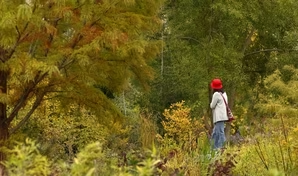
What it takes to save some of Earth’s most threatened plants
Video has Closed Captions
What it takes to save some of the world’s most threatened plant species (8m 6s)
Providing Support for PBS.org
Learn Moreabout PBS online sponsorship
- News and Public Affairs

FRONTLINE is investigative journalism that questions, explains and changes our world.

- News and Public Affairs

Amanpour and Company features conversations with leaders and decision makers.











Support for PBS provided by:
Major corporate funding for the PBS News Hour is provided by BDO, BNSF, Consumer Cellular, American Cruise Lines, and Raymond James. Funding for the PBS NewsHour Weekend is provided by...